


Hair transplant statistics: age, who gets one, and which areas
October 24, 2026 | by Dra. Evelyn Alfonso

At what age does hair start to fall out? Who gets hair transplants, and on what part of the body? Data from the International Society of Hair Restoration Surgery (ISHRS), which surveys physicians around the world every few years, provide very clear answers. Here we summarize the most relevant hair transplant statistics.
Before the numbers: where these data come from
The figures in this article come from the ISHRS practice censuses; the ISHRS is one of the leading medical societies in hair restoration surgery. It is worth knowing how they are built in order to interpret them correctly:
- They are surveys of physicians. The ISHRS asks specialists in different countries how many procedures they perform, on what types of patients, and in which areas. Global estimates are projected from those responses.
- They are approximations. That is why we speak of figures that are “close to” or “about.” They are useful for seeing trends and orders of magnitude, not for knowing an exact number.
- They don’t include everything that happens in the world. Procedures performed in unregulated places are unlikely to be recorded, so actual activity could be different.
- They are not data from Chile. Regional figures group many countries together. They serve as a general reference, but they do not describe exactly what happens in our country.
With this in mind, the numbers are very useful for understanding how hair loss behaves and who seeks to treat it.
At what age does hair fall out the most?
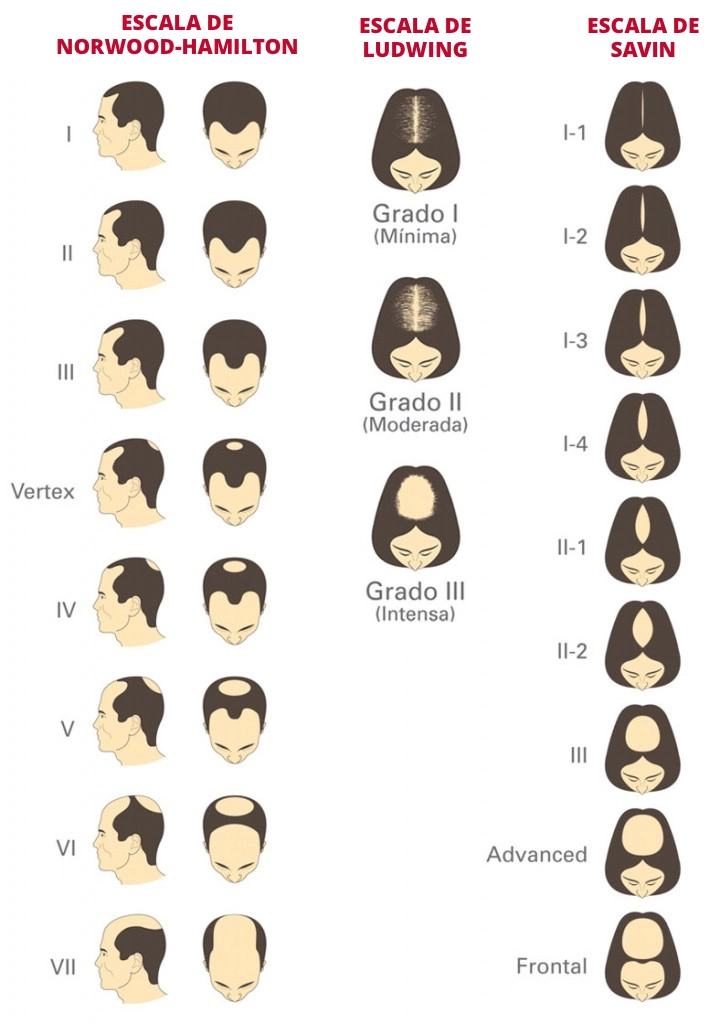
The most common cause of baldness is androgenetic alopecia, which is hereditary and hormonal in origin. In men it usually begins between the ages of 20 and 30 with a receding hairline or loss at the crown, and it is progressive: it is estimated that about half of men have some degree of baldness by age 50.
In women the pattern is different: the loss is more diffuse, on the top of the head, and it increases especially after menopause, although it can also appear earlier due to hormonal changes, thyroid problems, iron deficiency, or postpartum. We explain it in alopecia in women.
Note: losing between 50 and 100 hairs a day is normal. If you notice more, see normal hair loss or alopecia: when to worry.
How many hair transplants are performed worldwide?
According to the ISHRS 2022 census, about 703,000 hair restoration surgeries were performed worldwide in 2021. By region, the estimated distribution was:
- Asia and Australia: about 257,000
- United States and Canada: about 149,000
- Middle East and Africa: about 124,000 (includes Turkey, one of the major medical tourism destinations)
- Europe: about 113,000
- Mexico, Central and South America: about 60,000
Latin America still has a lower figure, but it is one of the regions where demand is growing the most.
What do these figures mean for you?
Beyond the regional ranking, the underlying message is simple: hair transplantation is a common and well-established procedure all over the world. It is not an experimental technique or something reserved for celebrities. If you are thinking about getting one, you are far from the only one.
The existence of major medical tourism destinations also does not mean you have to travel to get a good result. What determines the result is the diagnosis, the experience of whoever operates on you, the conditions of the operating room, and the follow-up afterward. If you are comparing options, see hair transplant in Chile or in Turkey, where we analyze the advantages and risks of each alternative.
And if you are interested in how Chile compares with other countries in terms of baldness, we have an article on the world baldness ranking and Chile.
Who gets hair transplants?
Men and women
87% of patients are men and 13% are women. But women are the fastest-growing group: according to the ISHRS 2025 census, the number of female patients operated on rose by 16.5% between 2021 and 2024.
Patient age
Most patients have surgery between the ages of 30 and 49: among men, 29% are between 30 and 39 and 28% between 40 and 49. 18% are between 20 and 29. The most recent census also shows that patients are coming in for consultations at increasingly younger ages.
Having surgery very young is not always the best idea: if the alopecia is still active, it can keep progressing around the transplanted hair. That is why it is key to combine the transplant with medical treatment and with a diagnosis by trichoscopy.
If you are young and already notice hair loss: what to do
The fact that patients are coming in younger and younger is good news in one sense: seeking a consultation in time lets you take care of the hair you still have. But it also calls for caution. These are some sensible steps:
- First, the diagnosis. Confirm what type of alopecia you have and what stage it is in. You can read about the types of alopecia and the hair loss patterns.
- Then, medical treatment. In many cases the first step is to stabilize hair loss. At Clínica Lumos we work with a Hair Protocol designed for that.
- Surgery, when appropriate. A transplant makes more sense when the hair loss is better defined and the design can be planned for the long term. We explain it in at what age to get a hair implant.
Having surgery too soon, without treatment and without a plan, can lead to results that look unnatural over the years. A good specialist will tell you honestly if it is not the right time yet.
In which areas of the body are the most transplants performed?
- Scalp: 87% of procedures in men and 83% in women.
- Eyebrows: the second most treated area in women (about 11%). Learn about the eyebrow implant.
- Beard and mustache: the second area in men (about 4%). Learn about the beard implant.
- Repair of scars and poorly performed transplants: between 2% and 4% of cases.
The trend is clear: transplants outside the scalp (eyebrows, beard, body) went from 13% to 18% in men and from 17% to 21% in women between 2021 and 2024.
What do the data tell us about eyebrows and beards?
The growth of transplants outside the scalp shows that hair restoration is no longer just about baldness. Many people seek to correct sparse eyebrows, for example after years of plucking, or to fill in a beard that grows with gaps. In these areas the design is even more delicate, because the direction and angle of each hair are very visible. If you are interested, see our eyebrow implant technique.
The worrying figure: clandestine clinics
59% of the physicians surveyed by the ISHRS in 2025 say that unregulated clinics operate in their city, and surgeries to repair those transplants already account for an average of 10% of their cases. Before having surgery, make sure you are operated on by a physician and that the operating room is authorized.
How to protect yourself from an unregulated clinic
This is probably the most important figure in the article for a patient. A hair transplant is surgery, and as such it must be performed under the right conditions. Before deciding, check:
- Who evaluates you and who operates on you. Ask directly whether the physician will be present and in charge of the procedure, or whether it will be performed by technical staff. At Clínica Lumos, Dr. Evelyn Alfonso personally evaluates each patient and leads every procedure.
- The facility’s authorization. In Chile, the operating room must have health authority approval. You can learn how we work in safe clinic.
- A real evaluation before you are given a price. Be wary of fixed quotes given without examining your scalp or your donor area. For guidance, see the price of a hair transplant in Chile.
- Pre-operative tests. They are part of safe surgery. At our clinic they can be taken on site; we tell you which ones they are in trichological evaluation and tests.
- Follow-up after surgery. Ask how they will support you in the following weeks and months. Our patients have contact via WhatsApp during treatment.
If you already had surgery somewhere else and the result is not what you expected, there are alternatives. We explain them in correction of a hair transplant done at another clinic.
How to read these statistics with good judgment
The figures help you understand the big picture, but your case is unique. Some common mistakes when interpreting these data:
- “If most people have surgery at a certain age, I should too.” No. Age is just one factor; the type of alopecia, how fast it progresses, and your donor area matter more.
- “If it is so common, it is a simple procedure.” Being common does not make it minor. It is still surgery that requires planning and experience.
- “Women don’t get transplants.” They are a minority, but a growing group. Female alopecia needs an especially careful diagnosis.
- “If there are many clinics, they are all the same.” Precisely because there is more on offer, it is more important to check who operates and under what conditions.
When to seek a consultation?
We recommend asking for an evaluation if you notice the hair loss increasing, if your temples or crown are receding, if there is a family history of baldness, or if you simply want to know what stage you are at. A diagnosis with trichoscopy with artificial intelligence lets you see the condition of your follicles in much more detail than with the naked eye.
Frequently asked questions
Do the ISHRS statistics apply to Chile?
They are global and regional data. Chile is part of the Mexico, Central and South America group, but the figures do not describe exactly what happens in our country. They serve as a general reference.
Why do more men than women have surgery?
Mainly because male androgenetic alopecia usually has a more localized pattern, such as the temples and crown, which is very well suited to a transplant. In women the loss is usually more diffuse and surgery is not always the best option.
Is there an ideal age for a hair transplant?
There is no single age. What matters is that the alopecia has been diagnosed, ideally stabilized with treatment, and that the design takes into account how you will look in the future.
Does a transplant stop hair loss?
No. Transplanted hair comes from the donor area and is resistant to hair loss, but hair that was not transplanted can keep falling out if it is not treated. More in does a hair implant fall out or is it long-lasting?
How do I know if I am losing more hair than normal?
If you notice more hair than usual in the shower, on your pillow, or on your comb, or you see less density in photos, it is worth seeking a consultation. Also see hair in the shower: is it hair loss?
In summary
The ISHRS statistics show that hair transplantation is a very common procedure worldwide, sought mostly by men but increasingly by women, that patients are seeking consultations at younger and younger ages, and that eyebrows and beards are gaining ground. They also leave a clear warning: unregulated clinics are a real problem. For you, the practical conclusion is that the numbers offer guidance, but the decision should be based on a personal diagnosis and on a medical team that works under safe conditions.
Book your evaluation
At Clínica Lumos, Viña del Mar, every transplant is performed by Dr. Evelyn Alfonso in an operating room authorized by the SEREMI de Salud (regional health authority), after a complete trichological evaluation.
Want to know which option is right for you? Book your evaluation with Dr. Evelyn Alfonso at Clínica Lumos, Viña del Mar.
Follow real cases, before-and-afters, and day-to-day life at the clinic on Instagram: @lumos_chile and @dra_alfonso. If you have questions, message us on WhatsApp and we will reply in less than an hour.
Sources: ISHRS Practice Census 2022 and 2025 (International Society of Hair Restoration Surgery).
This information is educational and does not replace a medical evaluation.
Keep reading
Most read
RELATED POSTS
View all

Trichological evaluation: what tests we do before a hair transplant
October 16, 2026 | by Dra. Evelyn Alfonso
Over 200 patients a month: how we work at Clínica Lumos
October 16, 2026 | by Dra. Evelyn Alfonso
FUE, FUSS (Strip) or No-Shave FUE: Hair Transplant Techniques Comparison Table
October 24, 2026 | by Dra. Evelyn Alfonso
Comments (0)
No comments yet. Be the first to ask!