

Seeing hair in the shower or bathroom? What to do if your hair is falling out
October 23, 2026 | by Dra. Evelyn Alfonso

Seeing hair in the shower or bathroom? What to do if your hair is falling out
October 23, 2026 · By Dr. Evelyn Alfonso
You see hair in the shower drain, on your brush or on your pillow, and the question comes up: am I going bald? Before you panic, it helps to know what is normal and what is not.
Losing hair every day is normal
Hair renews itself in cycles: each hair grows for years, rests and then falls out to make way for a new one. That is why it is common to lose between 50 and 100 hairs a day. On the days you wash your hair it may seem like more, because the hairs that were already about to fall come loose all at once.
Why it seems like so much in the shower
The shower is where shedding is most noticeable, and there are simple reasons for that. When you wet your hair and massage your scalp with shampoo, all the hairs that were already in the resting phase come loose together. If you skip washing your hair for a couple of days, those hairs build up and all come out in the next wash. Also, wet hair clumps together and looks like more in the drain than when it is dry and loose in your brush.
That is why it is not a good idea to draw conclusions from a single day. What matters is the trend: if for several weeks you clearly see more hair than before, or if you also notice changes in how your hair looks, it is worth looking into.
Shedding or breakage: they are not the same
Not every hair you find in the shower fell out from the root. A hair that falls out as part of its natural cycle usually has a small whitish bulb at one end. A broken hair, on the other hand, snaps partway along and has no bulb. Breakage is usually related to damage to the hair fiber: excessive heat, frequent dyeing or bleaching, chemical straightening or very tight hairstyles. It is not alopecia, but it also deserves care. If you are wondering whether shower temperature plays a role, read does hot water make your hair fall out?
How to keep track at home without obsessing
- Take photos regularly of your part, hairline and crown, always with the same lighting and from the same distance.
- Write down recent changes: illnesses, surgeries, childbirth, diets, stress, new medications. Telogen effluvium appears with a delay, so the cause may be several months back.
- Look at the thickness: if the hairs that fall out or the ones that remain look thinner and thinner, there may be miniaturization, which is typical of androgenetic alopecia.
- Do not count hairs every day: it creates anxiety and the number varies a lot from one day to the next.
Signs that you should see a doctor
- You see clumps of hair in the shower or on your pillow for several weeks.
- Your part looks wider or your scalp shows more under certain lighting.
- Your temples or crown are thinner than before.
- Your ponytail is thinner.
- There is itching, redness, flaking or patches of sudden hair loss.
Common causes
- Androgenetic alopecia: the most common cause in men and also frequent in women. It is progressive.
- Telogen effluvium: intense and usually temporary shedding, a few months after severe stress, an illness, a strict diet or childbirth.
- Deficiencies or hormonal changes: for example iron or thyroid.
Learn more in types of alopecia and, if you are a woman, in female alopecia.
Other causes that are also considered
- Alopecia areata: round patches without hair appear, sometimes suddenly.
- Traction alopecia: from habitually wearing very tight hairstyles, such as tight ponytails or braids.
- Scalp problems: seborrheic dermatitis, psoriasis or other inflammation that may come with itching and flaking.
- Medications and treatments: some drugs may be associated with hair loss. Never stop a medication on your own: talk to your doctor about it.
Where you lose hair also offers clues. In men, androgenetic alopecia usually starts at the temples or the crown, while in women a widening part is more common. You can read more in alopecia patterns: where you lose hair, hair loss at the crown and alopecia in women.
What to do
- Do not self-medicate with miracle products: first you need to know the cause.
- Book an evaluation: with an AI-assisted trichoscopy we measure hair density and thickness, and check for miniaturization.
- Tests: depending on the case, blood tests are ordered to rule out treatable causes.
- Treatment: it may be a non-surgical Hair Protocol or, if the follicles can no longer be recovered, an FUE hair transplant.
The sooner you see a doctor, the more options there are to keep the hair you still have.
Habits that help care for your hair
No habit replaces a diagnosis, but there are things that do help while you find out what is going on:
- Wash with lukewarm water and a gentle shampoo, massaging with your fingertips, without scratching with your nails.
- Detangle gently, from ends to roots, and use a wide-tooth comb when your hair is damp.
- Go easy on the heat from the hair dryer, flat iron and curling iron, and use a heat protectant.
- Vary your hairstyles and avoid very tight ponytails, buns or braids every day.
- Watch your diet: very restrictive diets or rapid weight loss can trigger shedding. A varied diet with enough protein is part of hair care.
- Sleep and rest: sustained stress and lack of sleep affect the whole body, including your hair.
- Avoid supplements without a prescription: taking vitamins “just in case” does not always help and, in some cases, can be counterproductive. If there is a deficiency, your doctor will tell you how to correct it.
When hair loss affects your mood
Seeing hair in the shower every day can cause a lot of distress, and that is completely understandable. For many people, hair is closely tied to how they feel about themselves. If this happens to you, do not downplay it or wait for it to “pass”. Seeing a doctor early not only opens up more treatment options, it also gives you concrete information instead of guesswork, and that usually brings peace of mind. In many cases hair loss has an identifiable cause and a clear plan to address it.
What to expect from a hair evaluation
Seeing a doctor does not mean you will end up having surgery. In most cases, the first goal is to understand what is going on. At Clínica Lumos, Dr. Evelyn Alfonso evaluates you personally:
- She talks with you about when you started noticing the shedding, what it is like, your family history and the treatments you have tried.
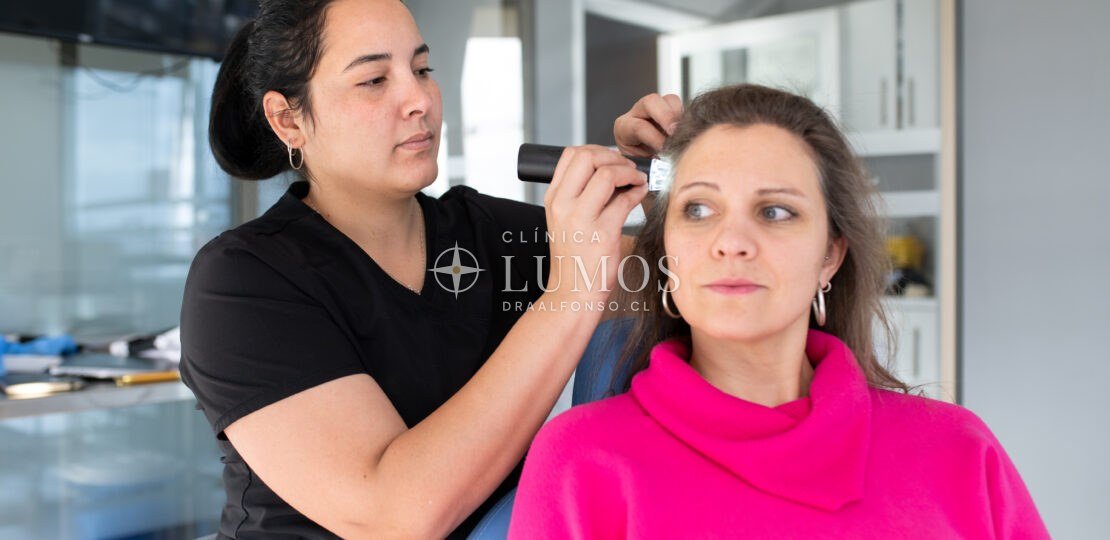
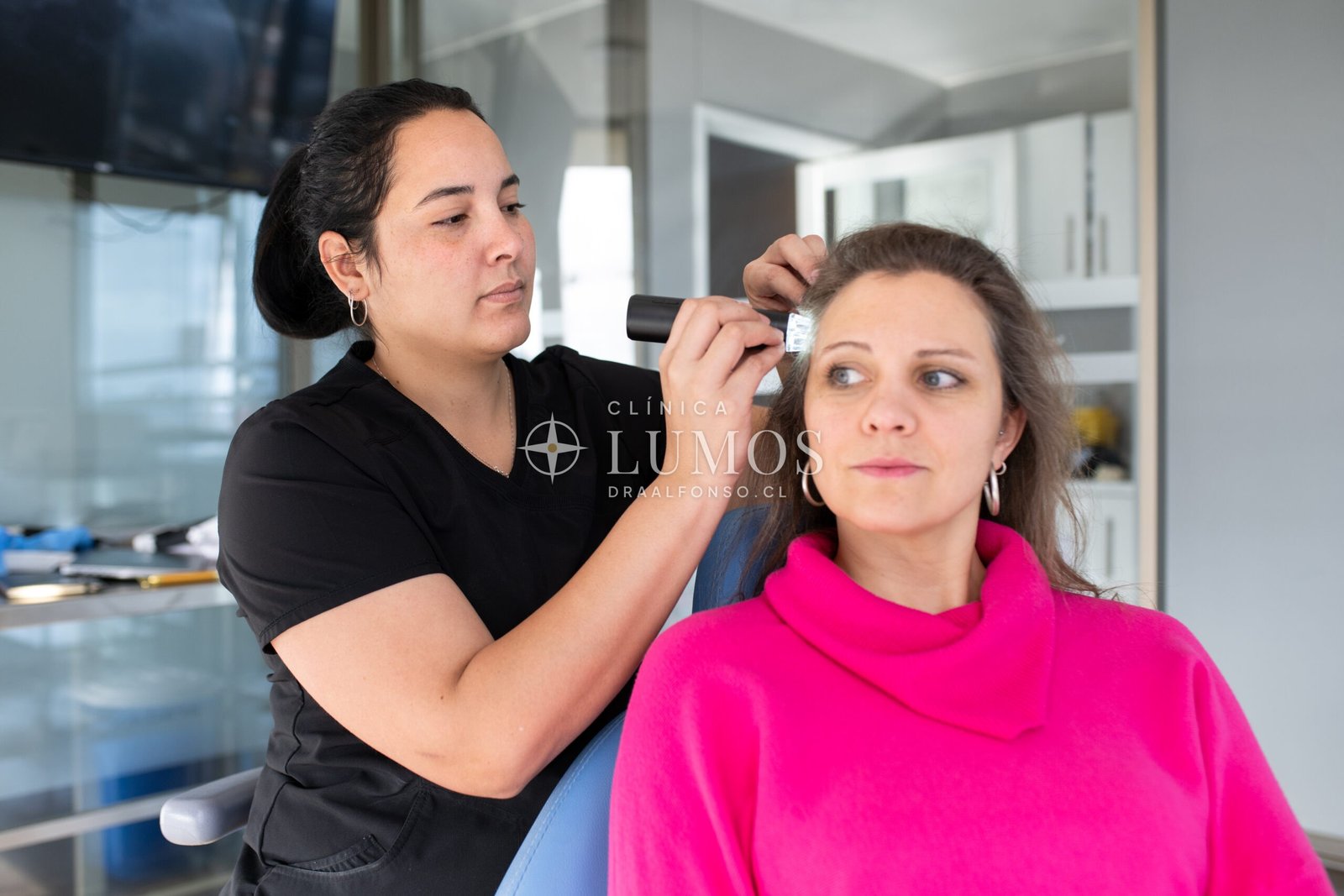
- She examines your scalp and performs a trichoscopy, which reveals what cannot be seen with the naked eye: density, thickness and miniaturization.
- If appropriate, she orders tests to rule out treatable causes.
- She explains the diagnosis and the alternatives, with realistic expectations.
What happens if I wait?
It depends on the cause. Telogen effluvium often resolves on its own once the factor that triggered it goes away, although hair takes months to regain its volume. Androgenetic alopecia, on the other hand, is progressive: the affected follicles gradually miniaturize, produce thinner and thinner hairs and, over time, some stop producing hair altogether. That is why it is important not to let years go by: while the follicle is still alive, medical treatment has more room to help you keep what you have. And if at some point you are interested in a transplant, knowing how your hair loss progresses makes it possible to plan it better.
Common myths
“Washing your hair often makes it fall out”
No. Washing only releases the hairs that were already about to fall. Washing less does not reduce shedding; it just makes you notice it all at once.
“Wearing a hat or cap causes baldness”
A regular hat does not cause alopecia. What can cause damage is the constant traction of very tight hairstyles.
“If it is genetic, there is nothing to be done”
Androgenetic alopecia is progressive, but there are medical treatments that can help slow it down or improve it in many cases, and a hair transplant is an option when the follicles can no longer recover. The earlier it is diagnosed, the more options there are.
“Stress has nothing to do with it”
A period of intense stress can trigger telogen effluvium, which is usually noticed a few months later. It often recovers, but it is best to confirm the diagnosis.
Frequently asked questions
How much hair is it normal to lose per day?
It is common to lose between 50 and 100 hairs a day. On wash days it may seem like more, because the hairs that were already about to fall come loose together.
Is hair loss after childbirth normal?
It is common to notice more shedding a few months after giving birth, and it is generally temporary. If it lasts or you notice thinner areas, see a doctor.
Can hair that has fallen out grow back?
It depends on the cause. In telogen effluvium the follicle is still alive and usually produces hair again. In advanced androgenetic alopecia some follicles can no longer recover, and that is where the diagnosis defines the alternatives.
Do anti-hair-loss shampoos work?
A suitable shampoo takes care of the scalp, but on its own it does not treat the cause of alopecia. Treatment should be prescribed by a doctor based on your diagnosis.
When should I see a doctor?
If the shedding continues for several weeks, if you see changes in your hair density or if there are symptoms such as intense itching, flaking or patches without hair.
In summary
Seeing hair in the shower is normal: it is part of the hair renewal cycle. What matters is the trend and the changes in your density. If the shedding lasts for weeks, if your part widens or your temples or crown thin out, it is best to see a doctor to find the cause and treat it in time. If you want to put your mind at ease, book your evaluation with Dr. Evelyn Alfonso in Viña del Mar.
This information is educational and does not replace a medical evaluation.
Hair Transplant and Liposuction in Viña del Mar, Valparaíso
Keep reading
Most read
RELATED POSTS
View all


Hair transplant statistics: age, who gets one, and which areas
October 24, 2026 | by Dra. Evelyn Alfonso

FUE, FUSS (Strip) or No-Shave FUE: Hair Transplant Techniques Comparison Table
October 24, 2026 | by Dra. Evelyn Alfonso
Comments (0)
No comments yet. Be the first to ask!