

Eyebrow implant without shaving: the Lumos Technique
October 23, 2026 | by Dra. Evelyn Alfonso


Eyebrow implant without shaving: the Lumos Technique
October 23, 2026 · By Dr. Evelyn Alfonso
We redesign your eyebrows and increase their density using your own follicles, without needing to fully shave the donor area.
Eyebrows frame the eyes and play a big role in facial expression. When they are sparse, have gaps, or have lost their shape, many people turn to daily makeup, tattooing, or microblading. An eyebrow implant is another alternative: instead of drawing, your own follicles are moved so that real hair grows. In this article we explain how we work with the Lumos technique, who can be a candidate, what recovery is like, what care is needed, and what expectations are realistic.
The Lumos Technique: how we work
- Eyebrow design according to your features.
- Careful selection of each follicle, ideally single-hair, to imitate the fine texture of the eyebrow.
- Follicle-by-follicle implantation.
- Control of direction, angle, and distribution, like the natural growth of the eyebrow.
- No full shaving of the donor area.
- Progressive, natural result.
We don’t draw an eyebrow: we rebuild it follicle by follicle. Unlike microblading, the result is real hair that grows and can be trimmed.
Why eyebrows are lost or weakened
Eyebrows can become sparse for different reasons. Some of the most common are excessive or repeated plucking over the years, which can damage the follicles; scars from accidents, burns, or surgeries; a genetic predisposition to sparse eyebrows; and certain medical conditions, such as thyroid disorders, alopecia areata, or other hair and skin diseases. There are also people who simply want a denser eyebrow or a different shape.
Identifying the cause is important. If the loss is due to an active medical condition, the first step is to study and treat it, because an implant might not be the best option while that condition keeps progressing. That is why the evaluation is always the first step.
What makes an eyebrow look natural
A natural eyebrow is not a perfect or completely symmetrical line. It has a softer head, a denser body, and a tail that tapers. The hairs do not all come out in the same direction: they overlap, change angle, and form a pattern that gives texture. That is why, when designing an eyebrow, filling in an outline is not enough. You have to think about:
- The proportion with your face: where it starts, where it reaches its highest point, and where it ends.
- Gradual density: avoiding hard edges that would give away that it is an implant.
- Harmony with your current eyebrows: if you keep part of your eyebrows, the implanted follicles must blend with the existing hairs.
- Your expression: small changes in shape can make you look more serious, more surprised, or more tired, so they are designed carefully and together with you.
Who can be a candidate
In general, an eyebrow implant can be considered for people who:
- Have sparse, patchy, or asymmetrical eyebrows due to plucking, scars, or predisposition.
- Have a donor area with suitable follicles, usually at the back of the head.
- Do not have an active hair or skin disease in the eyebrow area, or have it under control.
- Have realistic expectations about the result and the time it takes.
Dr. Evelyn Alfonso personally evaluates each case to confirm whether you are a candidate and to design a plan suited to your face.
The procedure, step by step
1. Evaluation
We review the cause of the loss, the condition of your eyebrows, the skin in the area, and the quality of your donor area. We talk about the shape you would like and what is reasonable to achieve.
2. Design
The eyebrow is drawn according to your features: the shape of your eyes, your forehead, and your cheekbones, and the expression you want to keep. A very thick or very arched eyebrow can change your expression, so the design is approved with you before starting.
3. Extraction
Under local anesthesia, follicles are extracted from the donor area, without needing to shave it completely. Single-hair follicles are preferred, because they look more like the fine hair of the eyebrow.
4. Implantation
This is the most delicate stage. Eyebrow hairs grow almost flat against the skin and in directions that change along their length: at the head of the eyebrow they usually point upward and, toward the tail, they slant sideways. Respecting that angle and direction, follicle by follicle, is what allows a natural result.
5. Recovery
It is an outpatient procedure. In the following days, small scabs and some swelling may appear in the eyebrow area, which usually resolve within a few days with the prescribed care. During treatment you have direct contact via WhatsApp to answer questions.
How the result evolves
An eyebrow implant follows a cycle similar to that of a hair transplant. In the first few weeks it is common for the implanted hairs to fall out, while the follicle remains under the skin. Then, over the months, the new hair starts to grow progressively, and the result consolidates over time. That is why we talk about a progressive result: it requires patience, but the hair that grows is yours. If you want to understand this cycle better, read why the implant falls out at first and why it is long-lasting.
Eyebrow implant vs. microblading
- Microblading: a type of semi-permanent pigmentation that draws strokes on the skin. It does not make hair grow and fades over time, so it usually requires touch-ups.
- Eyebrow implant: moves your own follicles, which produce real hair. That hair grows, can be combed and trimmed, and does not fade over time like a pigment.
Neither option is better for everyone: it depends on what you are looking for, the condition of your eyebrows, and whether you are a candidate. At the evaluation we can discuss the advantages and limitations of each alternative.
Why it matters where and with whom you have it done
An eyebrow implant is a medical procedure, even though it involves a small area. It requires clinical evaluation, local anesthesia, careful handling of the follicles, and a safe environment. At Clínica Lumos, Dr. Evelyn Alfonso, trained in the FUE technique in Turkey, Italy, and Barcelona, personally evaluates each case and leads the procedure, which is performed in an operating room authorized by the SEREMI de Salud (regional health authority). If you are coming from Santiago, the clinic is in Viña del Mar, about an hour and a half away.
In addition, since the donor area is the same one used in hair transplants, it is important to plan sensibly, especially if you might need a scalp treatment in the future.
Care after the implant
- Don’t rub or scratch your eyebrows during the first few days.
- Follow the cleaning instructions the team gives you.
- Avoid makeup in the area until you are given the go-ahead.
- Protect yourself from the sun and avoid intense exercise in the first few days.
- Trim when necessary: since the hair comes from the scalp, it can grow longer than a natural eyebrow and require periodic trimming.
Myths about eyebrow implants
“The implanted hair looks like a tuft of scalp hair”
With careful selection of single-hair follicles and the right angle, the goal is to imitate the fine texture of the eyebrow. What can happen is that it grows longer and needs trimming.
“It is the same as microblading”
No. Microblading is a pigment on the skin; an implant produces real hair.
“The result can be seen the same day”
The design can be seen from the start, but the final result is progressive and takes months.
When to seek a consultation
Seek a consultation if your eyebrows have become sparse for no apparent reason, if hairless patches appear, if you notice loss in other areas of the body as well, or if you have itching or redness in the area. Eyebrow loss can have medical causes that are worth investigating. After an implant, contact the team if there is increasing pain, widespread redness, discharge, or fever.
Frequently asked questions
Does an eyebrow implant hurt?
It is performed under local anesthesia. The main discomfort is usually the moment it is applied; after that the procedure is well tolerated.
Do I have to shave my head?
No. With the Lumos technique the donor area is not fully shaved.
Can I combine it with microblading?
That is evaluated case by case. Talk with the doctor before getting any pigmentation in the area.
How long until I see the result?
Growth is progressive: the implanted hair usually falls out in the first few weeks and then grows back over the following months. The doctor will explain the expected timeline in your case.
What if I lost my eyebrows because of a disease?
First, that condition must be studied and, if appropriate, treated. In some cases, such as certain active alopecias, an implant may not be indicated until the disease is under control. The doctor will guide you according to your diagnosis and, if necessary, refer you to the appropriate specialist.
Is the result permanent?
Implanted follicles usually keep the characteristics of the area they come from, so the hair tends to be long-lasting. Even so, results vary from person to person.
In summary
An eyebrow implant with the Lumos technique rebuilds the eyebrow follicle by follicle with your own follicles, respecting your features and the natural direction of the hair, without full shaving of the donor area. The result is progressive, natural, and made of real hair. Learn about eyebrow transplant in Viña del Mar: candidates, step by step, care, and a before-and-after case. If you want to know whether it is right for you, book your evaluation.
Educational information. It does not replace a medical evaluation. Results vary from patient to patient.
Keep reading
Most read
RELATED POSTS
View all

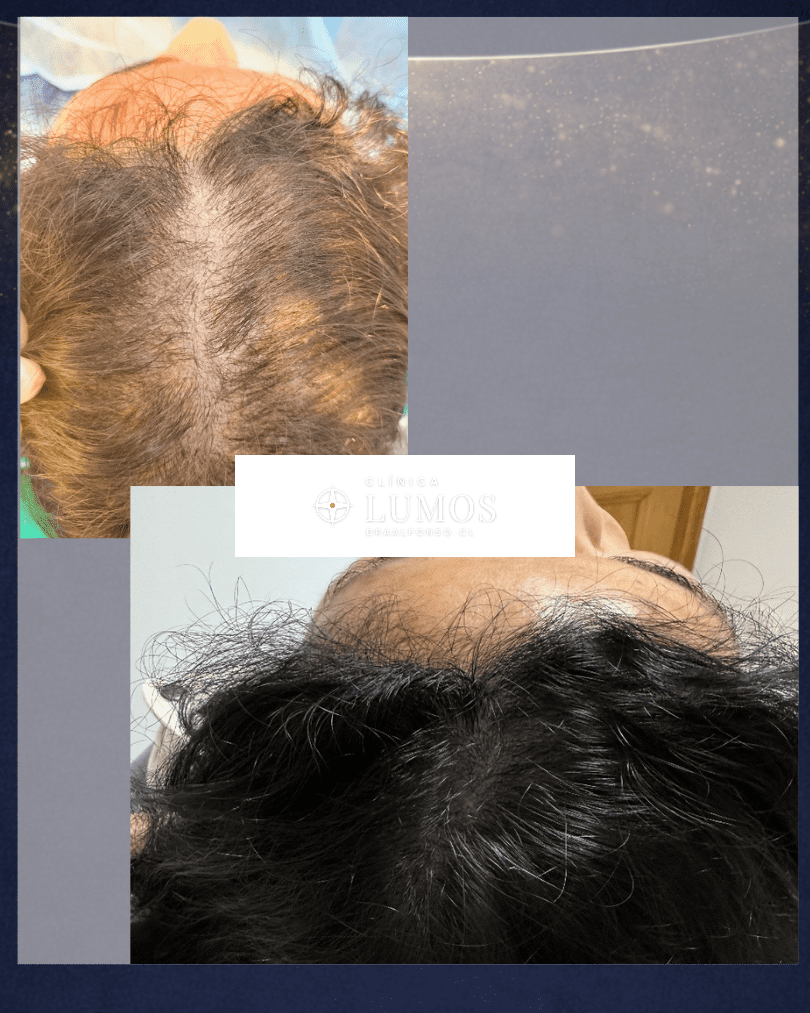
Female hair transplant: a case one year after the procedure
October 23, 2026 | by Dra. Evelyn Alfonso
Why choose Clínica Lumos for your hair transplant in Viña del Mar
October 16, 2026 | by Dra. Evelyn Alfonso

Over 200 patients a month: how we work at Clínica Lumos
October 16, 2026 | by Dra. Evelyn Alfonso
Comments (0)
No comments yet. Be the first to ask!