


Follicles vs. Hairs: How to Compare Hair Transplant Quotes Without Falling for Inflated Numbers
October 24, 2026 | by Dra. Evelyn Alfonso
One of the questions we hear most often at Clínica Lumos is: “How many hairs do I get for one million pesos?”. It is a logical question, but it stems from a confusion that makes it very hard to compare quotes between clinics: talking about hairs is not the same as talking about follicular units (grafts).
In short: a follicular unit is a small natural group of 1 to 4 hairs. That is why 2,000 follicular units can be equivalent to 4,000 or 5,000 hairs. If one quote talks about “hairs” and another about “grafts”, you are not comparing the same thing.
What is a follicular unit?
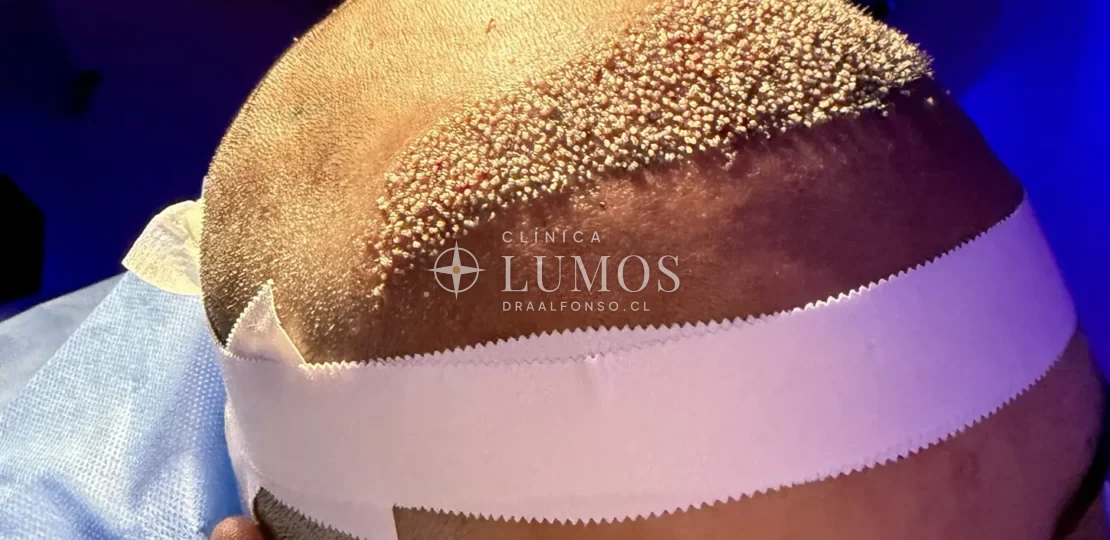
Hair does not grow in isolation. On the scalp, hairs grow in small groups or “families” called follicular units. Each one usually contains between 1 and 4 hairs, along with its sebaceous gland and small structures that nourish them.
In a hair transplant using the FUE technique, Dr. Alfonso extracts and places complete follicular units, one by one. The follicular unit is therefore the true working unit of the surgery: it is what is extracted, preserved and implanted.
Follicular unit vs. hair: the difference in numbers
| Type of unit | Hairs it contains | Where it is usually used |
|---|---|---|
| 1-hair unit | 1 | Hairline, for a natural design |
| 2-hair unit | 2 | Transition zone behind the hairline |
| 3–4-hair unit | 3 to 4 | Mid-scalp and crown, to add density |
The average varies between patients, but it is usually around 2 hairs per follicular unit. So a session of 2,000 follicular units can mean approximately 4,000 to 5,000 hairs. The exact number depends on your donor area, which is assessed before surgery (for example, with trichoscopy).
Why talking about “hairs” can inflate a quote
If one offer advertises “5,000 hairs” and another “2,000 grafts”, the first seems more generous, but they could be exactly the same surgery. Counting hairs instead of follicular units multiplies the figure without changing the result.
That is why, when comparing clinics, we recommend always asking for:
- The number of follicular units (grafts) planned, not just “hairs”.
- An estimate of hairs per unit based on your own donor area.
- Who performs the extraction and implantation: whether it is the doctor or technical staff.
- Where the surgery takes place: in Chile, surgery must be performed in an operating room authorized by the SEREMI de Salud (regional health authority).
So, how many hairs do you get for one million pesos?
There is no honest answer in “hairs per million”. The price of a hair transplant depends on the size of the area to be covered, the quality of the donor area, the technique (conventional FUE or no-shave FUE) and the number of follicular units that can be safely extracted without leaving the donor area depleted.
More units is not always better: the donor area is a limited resource and it is best to plan it with the long term in mind. In our guide to hair transplant prices in Chile we explain the factors that most influence the final cost.
How to read a hair transplant quote, step by step
When you have two or three quotes on the table, it is easy to focus only on the biggest number or the lowest price. We suggest reviewing them calmly, point by point, so that you compare equivalent surgeries and not just eye-catching figures.
1. Identify the unit of measurement
The first thing is to see whether the quote talks about follicular units, grafts or hairs. If one clinic uses “hairs” and another “grafts”, ask the first to express it in follicular units. If they cannot or will not, that in itself is valuable information.
2. Ask whether the figure is an estimate, a minimum or a maximum
Before surgery, the number of follicular units is always an estimate based on the evaluation of your donor area and the area to be covered. Ask how it was calculated, what happens if fewer units than planned are extracted during the procedure, and how the plan is adjusted in that case. A clear and honest answer usually says a lot about how a team works.
3. Check what each proposal includes
Two quotes with the same number of units may not include the same things. Ask whether it covers pre-operative tests, follow-up check-ups, medications and care instructions, and whether any complementary treatment is recommended to protect the hair you still have. That way you avoid surprises and can compare on equal terms.
4. Confirm who does each stage
Designing the hairline, extraction and implantation are technical steps that influence how the result will look. Ask directly who performs each one: whether the doctor is present throughout the procedure or only for part of it, and what the support team does.
5. Ask them to explain the long-term plan
Androgenetic alopecia is usually progressive. A good plan considers not only the area that looks thin today, but also how your hair loss might evolve over the coming years and how much reserve should be left in the donor area in case you need another procedure in the future.
Warning signs in a hair transplant offer
Not all attractive offers are bad, but there are some signs worth looking at carefully before deciding:
- Very high figures expressed in “hairs”, without explaining how many follicular units they correspond to.
- Fixed prices without having seen your scalp, for example based only on a photo sent by message.
- Promises of guaranteed results or of “getting back the hair you had at 18”.
- Offers of “maximum grafts” or “unlimited session”, which can put your donor area at risk.
- Little clarity about who operates or about the team’s training.
- Pressure to book quickly with discounts that expire within a few hours.
- No information about the place where the surgery is performed or about its health authorization.
If you are comparing with offers from abroad, in our article on hair transplant in Chile or in Turkey we review what questions to ask before traveling.
Common myths about grafts and hairs
“The more grafts, the better the result”
Not necessarily. The result depends on the units being well distributed, with a natural design and an appropriate density for each area. Extracting more than your donor area can tolerate can leave it visibly depleted and limit future options.
“The donor area regenerates”
The follicular units extracted are moved to the recipient area; they do not grow back in their original location. That is why the donor area is considered a finite resource that must be managed wisely.
“If I keep losing hair, the transplant failed”
Transplanted hair comes from an area that is usually more resistant to androgenetic alopecia, but the hair you already had in the treated area may continue to thin over the years. That is why it is often recommended to combine surgery with medical treatment, such as our Hair Protocol, as medically indicated.
We review other myths in our guide to FUE hair transplant myths.
Why your donor area determines the quote
Two people with a similar receding hairline may need very different plans. The density of your donor area (how many units there are per square centimeter), the thickness of each hair, the number of hairs per unit and the contrast between hair color and skin color all influence how much coverage can be achieved with the same number of follicular units.
That is why it makes no sense to set a “standard” number for everyone. At the evaluation your case is analyzed with tools such as AI-assisted trichoscopy, which helps to observe the donor area and hair miniaturization in more detail, and from there a realistic plan is proposed.
When to seek a consultation
We recommend requesting a medical evaluation if you notice your hairline receding, if your crown looks thinner in photos, if your hair looks increasingly fine or if you are already comparing quotes and do not know which one is realistic for your case. It is also wise to seek advice before starting any treatment on your own. If you are not sure whether surgery is right for you, you can read who is a good candidate for a hair transplant.
Medical transparency in the Valparaíso Region
At Clínica Lumos, quotes are expressed in follicular units, after a personal medical evaluation with Dr. Evelyn Alfonso, a member of FUE Europe and of the Chilean Society of Aesthetic Surgery and Medicine (SOCHIMCE). That way you know exactly what will be implanted and can compare with any other clinic on equal terms.
The evaluation is carried out personally by Dr. Alfonso, trained in the FUE technique in Turkey, Italy and Barcelona, who also leads each procedure. Surgery is performed in an operating room authorized by the SEREMI de Salud (regional health authority), pre-operative tests can be done at the clinic itself, and throughout treatment you stay in contact with the team via WhatsApp to answer your questions. If you are coming from Santiago, Clínica Lumos is approximately 1 hour 30 minutes away by car.
Frequently asked questions
How many hairs does a follicular unit have?
A follicular unit usually contains between 1 and 4 hairs. On average there are about 2 hairs per unit, although it varies from patient to patient.
Is a graft the same as a follicular unit?
In FUE hair transplantation, yes: each graft corresponds to a complete follicular unit, which can contain 1 to 4 hairs.
How many hairs are 2,000 follicular units?
Approximately between 4,000 and 5,000 hairs, depending on how many hairs, on average, each follicular unit in your donor area has.
How many follicular units do I need?
It depends on the area to be covered, the degree of alopecia and the quality of your donor area. It can only be estimated with an in-person medical evaluation.
How long does FUE hair transplant surgery take?
It is usually an outpatient surgery lasting several hours, under local anesthesia, whose duration depends on the number of follicular units to be implanted.
In summary
- A follicular unit is a natural group of 1 to 4 hairs; in FUE, each graft is a follicular unit.
- Talking about “hairs” instead of follicular units makes the figure seem bigger, even though the surgery is the same.
- To compare quotes, always ask for the number of follicular units, what each proposal includes, who operates and where.
- More units is not always better: your donor area is limited and it is best to plan it with the future in mind.
- Only an in-person medical evaluation can realistically estimate how many units you need.
If you want to clear up your doubts with a doctor who explains your case with clear numbers, you can book your hair evaluation at Clínica Lumos.
This information is educational and does not replace a medical evaluation.
Want to know how many follicular units you really need? Dr. Evelyn Alfonso evaluates you personally at Clínica Lumos, 10 Norte 875, Viña del Mar. Book your evaluation.
Results vary from patient to patient. This information does not replace a medical evaluation.
Keep reading
Most read
RELATED POSTS
View all


Chilean celebrities with a hair transplant: footballers and TV personalities who confirmed it
October 24, 2026 | by Dra. Evelyn Alfonso

After a hair transplant: what to expect from day 1 to month 12
October 22, 2026 | by Dra. Evelyn Alfonso
Over 200 patients a month: how we work at Clínica Lumos
October 16, 2026 | by Dra. Evelyn Alfonso
Comments (0)
No comments yet. Be the first to ask!