

Blog
Artículos de la Dra. Evelyn Alfonso sobre trasplante capilar, LipoVaser y medicina estética en Viña del Mar.
Most read
How much does LipoVaser cost in Chile? What affects the price and what your quote should include
October 24, 2026 | by Dra. Evelyn Alfonso

How to choose a hair transplant clinic in Chile: 10 questions to ask before surgery
October 24, 2026 | by Dra. Evelyn Alfonso
FUE, FUSS (Strip) or No-Shave FUE: Hair Transplant Techniques Comparison Table
October 24, 2026 | by Dra. Evelyn Alfonso
Follicles vs. Hairs: How to Compare Hair Transplant Quotes Without Falling for Inflated Numbers
October 24, 2026 | by Dra. Evelyn Alfonso
LipoLaser: how it helps tighten the skin and why you should be evaluated by a specialist
October 24, 2026 | by Dra. Evelyn Alfonso

Hair transplant statistics: age, who gets one, and which areas
October 24, 2026 | by Dra. Evelyn Alfonso
Chilean celebrities with a hair transplant: footballers and TV personalities who confirmed it
October 24, 2026 | by Dra. Evelyn Alfonso


Correcting a hair transplant done at another clinic
October 23, 2026 | by Dra. Evelyn Alfonso


Correcting a hair transplant done at another clinic
October 23, 2026 · By Dr. Evelyn Alfonso
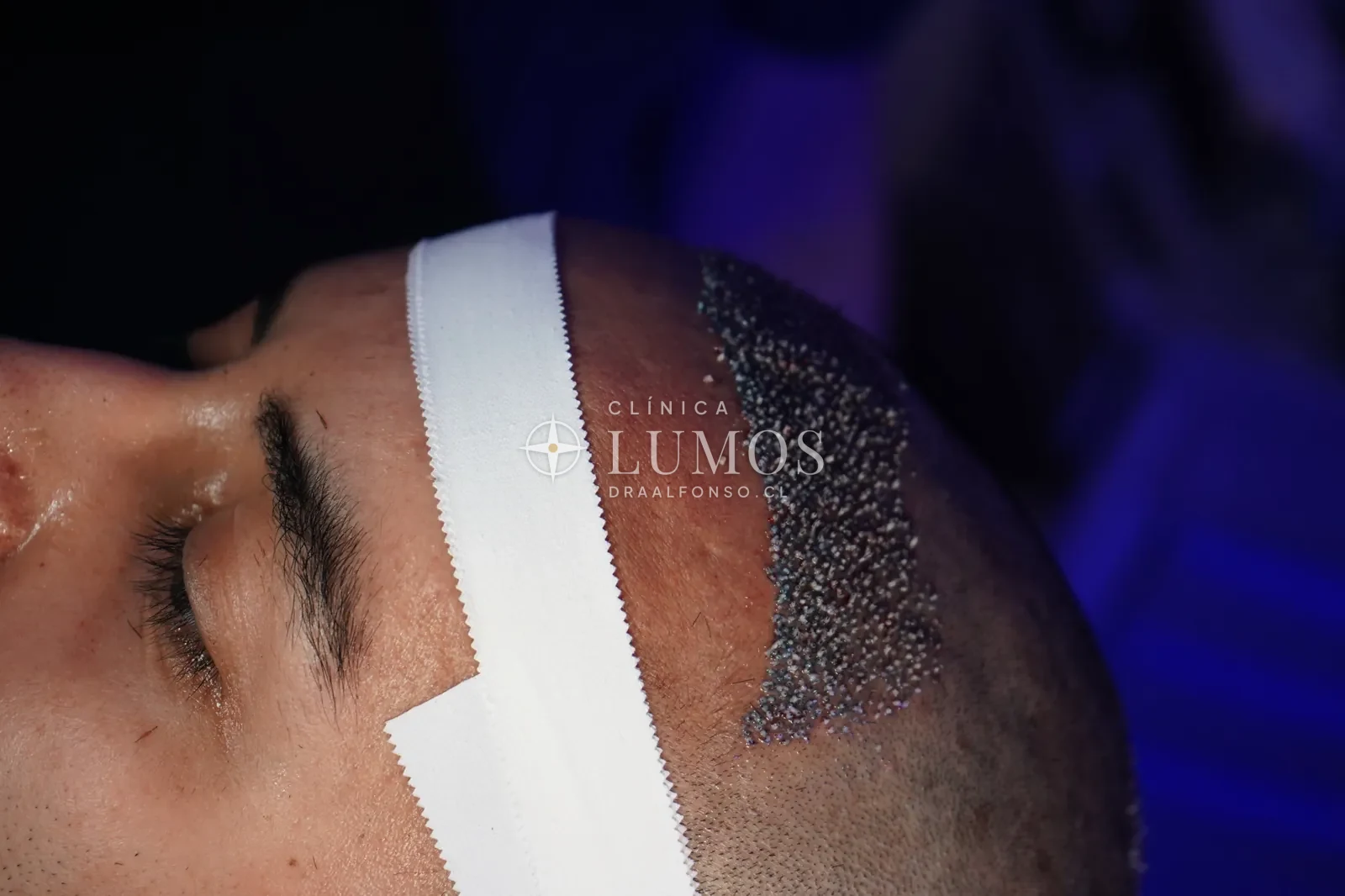
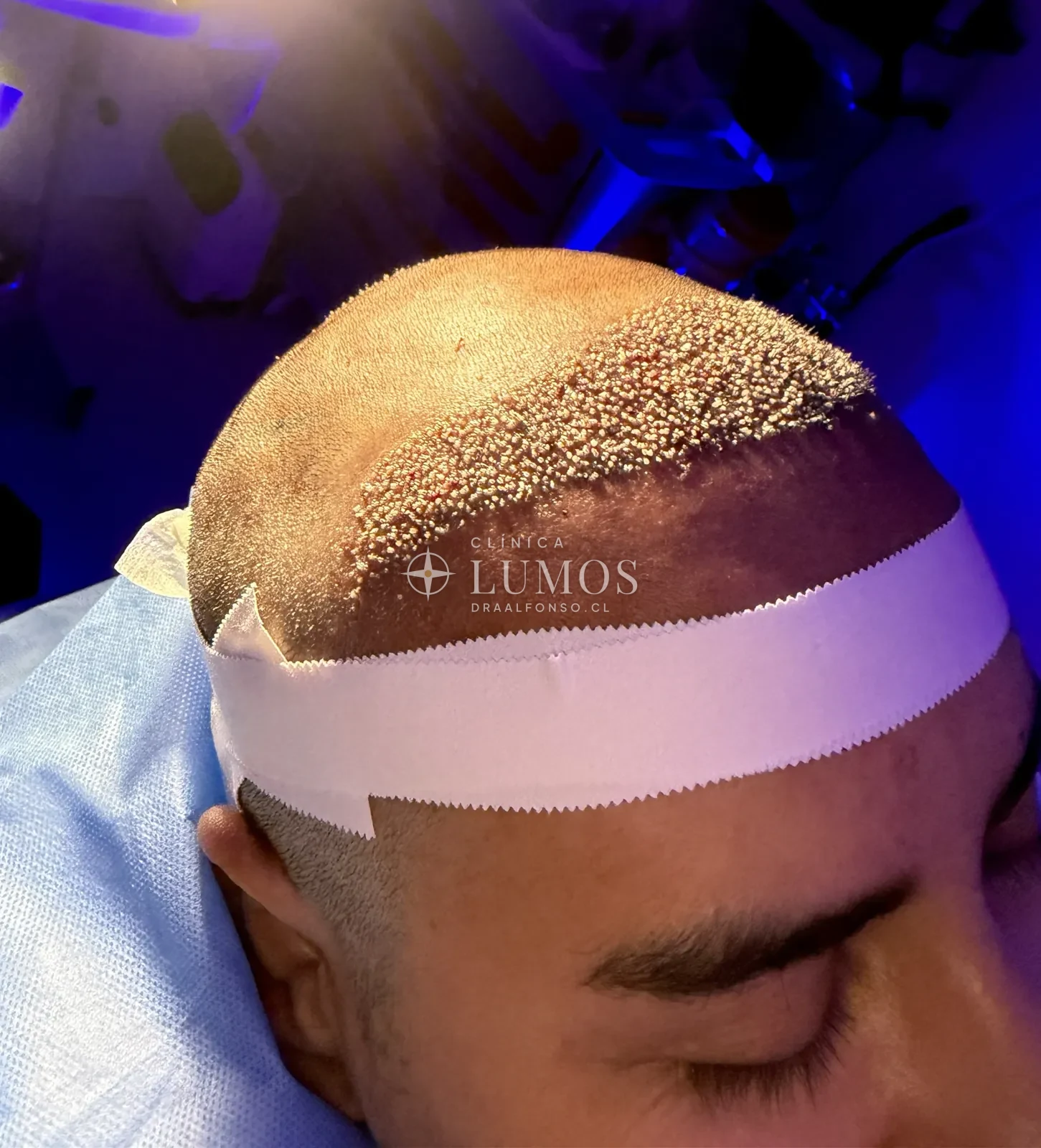
Some patients come to us after a transplant elsewhere, looking for more density or a more natural result. This is one of those cases:
If you are reading this, you have probably already had hair surgery and the result is not what you expected. Maybe the hairline looks stiff or too straight, perhaps some areas were left with low density, or the hair grows in a direction that does not let you style it the way you want. It is a frustrating situation, and it is normal to feel distrust before having surgery again. In this article we explain honestly what can be corrected, what cannot, and how we evaluate each case at Clínica Lumos.
What we aim for in a correction
At Clínica Lumos we apply our Lumos Densitytechnique, focused on maximizing hair density, optimizing every follicle and achieving a harmonious result even in complex cases.
A correction is not simply “a second transplant”. The goal is for the final result to look as if it had always been yours: a soft, irregular hairline, like a natural one, even density with no see-through areas, and follicles that follow the direction in which hair grows in each area of the head. To achieve this, Dr. Evelyn Alfonso personally evaluates each case and leads the procedure from start to finish.
Why a transplant may not turn out as you expected
Not all unsatisfactory results have the same cause. Understanding what happened helps plan the correction better. The most common reasons are:
- An unnatural design: hairlines that are too low, straight or dense at the edge, which do not suit the shape of your face or your age.
- Insufficient density: too few follicles were implanted for the area to be covered, or the grafts were distributed unevenly.
- Incorrect angle and direction: the hair sticks “straight up” or points in the wrong direction, which is especially noticeable when wet or styled.
- Use of thick units at the edge: single-hair follicles are usually preferred at the hairline to achieve a transition; if multi-hair units are used, the edge can look artificial.
- Progression of alopecia: sometimes the transplant turned out fine, but the native hair kept falling out and now the graft is “isolated”, surrounded by thinned areas.
- Overharvested donor area: excessive or uneven extraction can leave the back of the head with visibly lower density, which may also need attention.
Often the problem is not a single factor, but a combination of several. That is why, before talking about follicles or dates, the first step is a complete diagnosis.
What needs to be evaluated
- How much donor area is still available after the first procedure.
- The design and direction of the previously implanted follicles.
- How your alopecia has progressed since the first surgery.
Every correction requires planning, experience and precision: it is not just about implanting more, but about doing it right. Not all cases can be fully corrected, and Dr. Alfonso will tell you honestly during the evaluation.
To analyze these points in detail we use AI-assisted trichoscopy, which allows us to examine the scalp, density and condition of the follicles in both the recipient and donor areas. In addition, the doctor reviews your history: when you had surgery, how it progressed, whether you are using any treatment and what bothers you most about the current result.
What the correction process looks like, step by step
1. Evaluation and expectations
We talk about what you want to improve and what is realistic to achieve with the donor area you have today. The donor area is a limited resource: follicles that have already been extracted do not regenerate, so every available follicle is carefully planned.
2. Treatment of native hair
If your alopecia is still active, there is little point in correcting the graft without slowing the hair loss around it. In many cases a Hair Protocol is first recommended to strengthen the hair you still have. Medication, if appropriate, is always prescribed by the doctor according to your diagnosis.
3. Redesign
The new hairline and the areas to be densified are defined together with you. Sometimes it is enough to soften the edge by adding fine follicles in front; other times gaps need to be filled or the appearance of an area reoriented by implanting between the existing follicles in the correct direction.
4. Extraction and implantation
It is performed with the FUE technique, under local anesthesia, extracting follicles one by one and spreading out the extraction to protect the appearance of the back of the head. Implantation respects angle, direction and density, which is what determines whether the result will look natural.
5. Follow-up
After the procedure, the hair goes through the same stages as in any transplant: scabs in the first days, shedding of the implanted hair during the first weeks and gradual growth over the following months. You can read what the progression after a transplant looks like. During treatment you have direct contact via WhatsApp to answer questions.
What can usually be improved and what has more limits
Every case is different, but there are some general patterns that help understand what to expect:
- Usually has more room for improvement: softening a stiff hairline by adding fine follicles, increasing density in areas that were left thin and complementing areas where alopecia progressed after the first surgery.
- Requires more analysis: follicles implanted at a very sharp angle, hairlines placed too low or grafts grouped in visible “tufts”.
- Has more limits: cases in which the donor area has already been heavily used, because the number of available follicles determines how far we can go.
That is why, rather than promising you a result, in the evaluation we will show you what options exist with your hair, what their limits are and what can reasonably be expected.
How to prepare for your evaluation
To get the most out of the consultation, we suggest bringing photos of your hair before the first surgery and during its progression, any report you were given and the list of treatments you have used. It also helps to think about what bothers you most today: the hairline? the crown? the overall density? Being clear about your goal makes it possible to design a plan that focuses on what really matters to you. If you then decide to have surgery, pre-operative tests can be done at the clinic itself.
Tips if you are thinking about correcting your transplant
- Give the first result time: the result of a transplant is only visible between 10 and 12 months. Before that, it may be premature to decide on a correction.
- Gather information about your first surgery: date, approximate number of follicles, technique used and before and after photos are very helpful for the evaluation.
- Do not rush because of a deal: a poorly planned second surgery can deplete the donor area and leave you with fewer options.
- Ask who will operate: the procedure must be in the hands of a medical team, in an authorized operating room. At Lumos we operate in an operating room authorized by the SEREMI de Salud.
- Take care of your native hair: preserving what you have is part of the long-term result.
Common myths about corrections
“If the first one went wrong, the second will too”
Not necessarily. Many unsatisfactory results are due to design or technique decisions that can be improved. What matters is to properly evaluate what went wrong and whether there are resources to correct it.
“More follicles fix everything”
Not always. Implanting more without changing the design or direction can even worsen the appearance. Correction is about judgment, not just quantity.
“Badly placed transplanted hair can be removed without any problem”
In some cases poorly placed follicles can be removed or redistributed, but it is not always possible or advisable. It is a decision made case by case, after the evaluation.
When to get checked
We recommend booking an evaluation if, a year after your surgery, you notice any of these situations:
- The hairline looks artificial, very straight or “doll-like”.
- There are implanted areas with low density or visible gaps.
- The hair grows in a direction that makes it hard to style.
- Your native hair loss keeps progressing around the graft.
- The donor area looks less dense or has visible marks.
And if you have persistent pain, redness that does not go away, discharge or any symptom that worries you after surgery, see a doctor without waiting.
If you are thinking about your first transplant, read what to check before choosing where to have surgery.
Frequently asked questions
How long should I wait to correct a transplant?
In general, it is best to wait until the first transplant has completed its progression, which usually takes between 10 and 12 months. That way the real result can be seen before planning. The doctor will determine the right time in your case.
Can a bad result always be corrected?
Not always completely. It depends mainly on the available donor area, the condition of your scalp and the progression of your alopecia. In the evaluation we will tell you honestly what can be improved.
Does the correction leave more scars?
With the FUE technique, extraction is done follicle by follicle, leaving small, pinpoint marks. Planning a distributed extraction helps protect the appearance of the back of the head.
Can I correct a transplant done abroad?
Yes, it can be evaluated. Many people had surgery outside Chile and then seek to improve density or naturalness. Bring all the information and photos you have of your surgery.
Do I need medical treatment in addition to surgery?
Often yes, especially if the alopecia is still active. Treating native hair helps the result last over time. Any medication must be prescribed by a doctor.
In summary
A transplant that did not turn out as you expected is not always a lost cause. With a complete diagnosis, a careful redesign and planning that respects your donor area, it is often possible to achieve more density and a more natural result. Learn about the FUE hair transplant in Viña del Mar and see real patient results. If you want to know what can be done in your case, book your evaluation with Dr. Alfonso.
Educational information. It does not replace a medical evaluation. Results vary from patient to patient.