

Hair Loss on the Crown: Causes and Treatment
October 23, 2026 | by Dra. Evelyn Alfonso

Hair Loss on the Crown: Causes and Treatment
October 23, 2026 · By Dr. Evelyn Alfonso

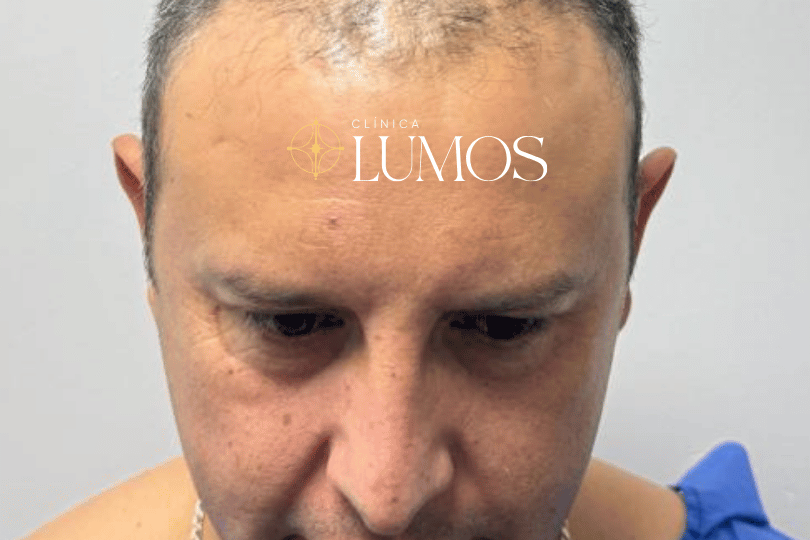
Does hair loss on your crown bother you? It is one of the areas that worries people most, because often you don’t see it until someone mentions it or it shows up in a photo. In this video we show you a patient’s case:
The case
This patient came to Clínica Lumos with localized hair loss on the crown. His evaluation determined that the best treatment for him was a hair transplant. In the video you can see his progress at 6 months; the final result is seen between 10 and 12 months.
His case is common: the crown is usually one of the first areas to lose density in men, and since it is out of our view in the mirror, hair loss progresses for months or years before we notice it. Below we explain why it happens, how to recognize the first signs, how it is diagnosed and what treatment options exist.
Why does hair fall out on the crown?
The most common cause is androgenetic alopecia: due to genetics and the action of dihydrotestosterone (DHT), the follicles on the crown weaken, the hair becomes finer and the area loses density. Other causes, such as alopecia areata or effluvium, can also affect it, which is why diagnosis is key. Learn about the types of alopecia.
Androgenetic alopecia
It is progressive and has a strong hereditary component. In men it usually combines receding temples and crown, which may merge over time. In women, diffuse thinning on the top of the head is more common, although the crown area and the part line may also look thinner.
Alopecia areata
It is an autoimmune condition in which round bald patches appear, sometimes suddenly. It can affect the crown, but its treatment is completely different and, in general, it is not treated with a transplant while it is active.
Telogen effluvium
It is diffuse, temporary shedding that appears weeks or months after intense stress, an illness, a high fever, a very restrictive diet or hormonal changes. It can make the crown look thinner, but it usually recovers once the cause is corrected.
Other contributing factors
Iron or other nutrient deficiencies, thyroid disorders, some medications and certain habits —such as smoking or hairstyles that pull on the hair— can worsen hair loss or add to an underlying alopecia.
First signs that you are losing hair on the crown
- You see more scalp in photos taken from above or under direct light.
- The hair whorl looks more open than before.
- When your hair is wet, the area looks clearly thinner.
- The hairs in that area are finer and shorter than those on the sides.
- Someone close to you or your hairdresser mentions it.
A useful trick is to take a photo of your crown with your phone every three months, with the same lighting and the same angle. Comparing those photos will give you a much clearer idea than looking with two mirrors.
How it is diagnosed
With AI-powered trichoscopy we measure density, thickness and miniaturization, and compare the crown with the donor area.
The evaluation also includes a medical history —when you first noticed the hair loss, family history, medications and other conditions— and, if needed, blood tests to rule out correctable causes. With that information we determine whether the follicles on the crown are still recoverable or are already very miniaturized.
Comparing the crown with the donor area is especially useful: if the crown has many fine hairs mixed with thick hairs, it is a typical sign of ongoing androgenetic alopecia. If density is low but the remaining hairs are thick and healthy, the cause may be something else. In addition, the initial measurement serves as a reference point for follow-up visits, so you can know with data whether the treatment is working and not rely only on your impression in the mirror.
Treatment options
- If there are weakened but living follicles: a Hair Protocol without surgery to slow hair loss and recover density.
- If the follicles are no longer recoverable: an FUE hair transplant, respecting the natural whorl direction of the hair on the crown.
The crown is a large area and hair loss there usually keeps progressing, so the plan must think long term and protect the native hair.
Treatment without surgery
When the diagnosis is early, many patients manage to slow hair loss and recover part of the density without surgery. There are medical treatments with good evidence for androgenetic alopecia, which must be prescribed and monitored by a specialist on a case-by-case basis. What matters is consistency: results are assessed in months, not weeks. Also read whether hair density can be improved without a transplant.
Hair transplant on the crown
Transplanting the crown has its own particularities. The hair there grows in a spiral from a whorl, so each graft must be implanted at the correct angle and direction for the result to look natural. In addition, it is a large area that may require many follicular units, and since hair loss on the crown usually keeps spreading toward the edges, you have to plan carefully how much of the donor area reserve is used.
In patients with receding temples and crown, the front is often prioritized, since it defines the face the most, and the crown is treated with a combined approach. Each plan is defined during the evaluation according to your goals and your donor area.
What to expect afterward
Between the 2nd and 4th week, the implanted hair falls out temporarily; from 3 or 4 months, the new hair begins to grow. On the crown, the full result may take a little longer to show than in the front area, sometimes up to 12 months or a bit more. Learn more about shock loss, a temporary shedding of native hair that can occur after surgery.
Habits that help care for the crown
No habit on its own stops genetic hair loss, but some care helps keep the hair in better condition and helps treatment work better:
- Protect yourself from the sun: the crown is one of the most exposed areas. If your hair is fine, wear a hat or sunscreen on very sunny days.
- Wash your hair normally: washing it often does not make it fall out more; the hairs you see in the shower were already in the shedding phase.
- Avoid pulling and tight hairstyles that put tension on the hair for long periods.
- Don’t smoke: tobacco affects scalp circulation.
- Take care of your diet and rest: a balanced diet and good sleep support healthier hair.
- Be wary of miracle solutions: products that promise to “regrow hair in 30 days” often waste valuable time that could be used to treat the problem early.
When should you see a doctor?
The sooner, the better. Androgenetic alopecia is easier to slow while the follicles are still alive. See a doctor if you notice your crown looks thinner than a year ago, if there is a family history of baldness and you want to get ahead of it, if the hair loss is sudden or appears in patches, or if it comes with itching, flaking or pain. An early diagnosis gives you more options and often avoids or postpones surgery.
Frequently asked questions
Is it normal to see scalp on the crown?
Under direct light, some scalp is visible at the whorl in almost everyone. What should be assessed is whether it has changed over time or whether the hair in that area looks finer than the rest.
Can hair loss on the crown be reversed?
If the follicles are still alive, timely treatment can slow hair loss and recover density. If they are no longer recoverable, a transplant is the alternative to cover the area again.
Can just the crown be transplanted?
Yes, if the evaluation indicates it. But you need to consider how the rest of your hair loss will progress so the result keeps looking natural over the years.
Do women also lose hair on the crown?
Yes, although in women it is usually part of more diffuse thinning on the top of the head. Diagnosis and treatment are adapted to that pattern.
How long does it take to see treatment results?
With medical treatment, the first changes are usually assessed from 3 to 6 months. With a transplant, the final result is seen between 10 and 12 months.
In summary
The crown is an area that tends to lose density without us noticing. The most important thing is to diagnose the cause in time: it can often be slowed without surgery, and when a transplant is needed, the design must respect the whorl and think long term.
If this is happening to you too, book your evaluation with Dr. Alfonso in Viña del Mar.
This information is educational and does not replace a medical evaluation. Results vary from patient to patient.
Trasplante Capilar y Liposucción en Viña del Mar, Valparaiso
Keep reading
Most read
RELATED POSTS
View all


Eyebrow implant without shaving: the Lumos Technique
October 23, 2026 | by Dra. Evelyn Alfonso

Hair transplant statistics: age, who gets one, and which areas
October 24, 2026 | by Dra. Evelyn Alfonso

Am I a candidate for a hair transplant? Signs, age and realistic expectations
October 16, 2026 | by Dra. Evelyn Alfonso
Comments (0)
No comments yet. Be the first to ask!