

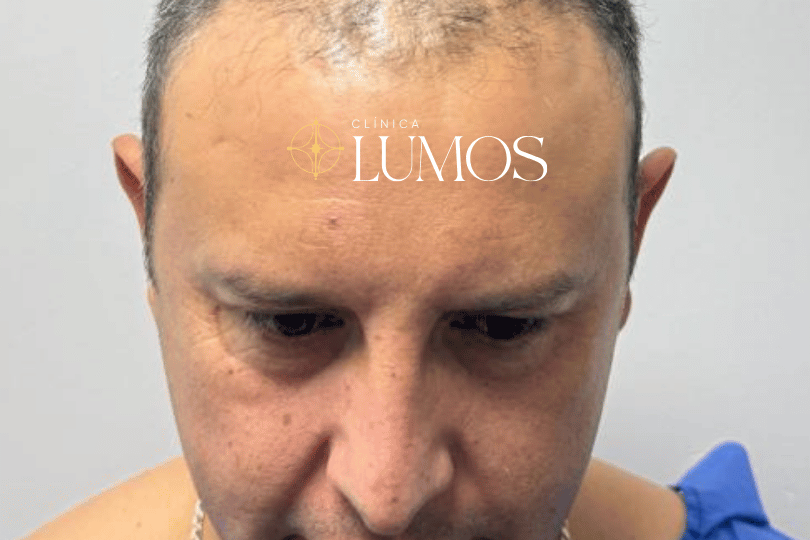

Myths and facts about FUE hair transplants
October 16, 2026 · By Dr. Evelyn Alfonso
Few areas of aesthetic medicine generate as many myths as hair transplants. Between forums, videos and stories from acquaintances, a lot of information circulates that is not always correct. As an FUE technique specialist and a member of FUE Europe, Dr. Evelyn Alfonso answers the most common myths we hear in consultations.
- Dr. Alfonso evaluates you personally
- WhatsApp reply in under 1 hour
- 5.0 on Google · 33 reviews
The problem with myths is not just that they are wrong: it is that they lead to bad decisions. Some people put off an evaluation for years because they believe it “hurts like crazy” or that “you can spot it a mile away”, and others have surgery thinking it is a quick formality with no care or risks. The reality lies somewhere in between, and knowing it lets you arrive at your consultation with realistic expectations and better questions.
What the FUE technique really is
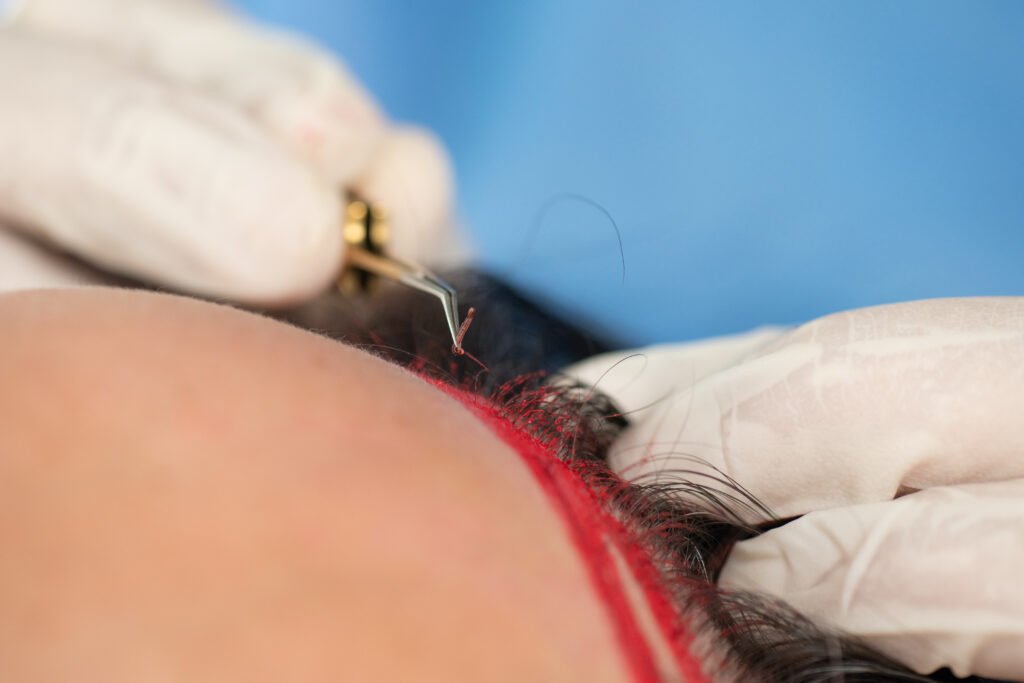
Before going over the myths, it is worth understanding what the procedure involves. In the FUE technique, follicular units (small groups of one to several hairs with their root) are extracted one by one from a donor area, usually the back and sides of the head. They are then implanted in the areas with lower density, following a design that respects the natural direction, angle and distribution of the hair.
Hair from the donor area is chosen because it is usually resistant to the hormonal effect that causes androgenetic alopecia. That is why, when it is moved, it tends to keep that characteristic. If you want to know how the day unfolds, we tell you in hair transplant day step by step.
Myth 1: It is a non-surgical procedure
False. The FUE technique, Follicular Unit Excision, involves surgical incisions to extract and implant each follicular unit. It is outpatient and minimally invasive, but it is still a surgical procedure that requires proper protocols and an operating room.
This has practical implications: it requires a prior evaluation, pre-operative tests, local anesthesia, a sterile environment and a trained team. At Clínica Lumos the procedure is performed in an operating room authorized by the SEREMI de Salud (regional health authority), and pre-operative tests can be done at the clinic itself. Be wary of any offer that presents it as a “quick cosmetic treatment” without these conditions.
Myth 2: It leaves no scar at all
That is not accurate either. FUE leaves tiny dots in the donor area, much less visible than the linear scar of other older techniques, but they can be noticeable with very short hair.
With hair of a normal length, these dots are usually covered. Their visibility depends on factors such as the number of grafts extracted, how the extraction is distributed, skin type and each person’s healing. A well-distributed extraction also aims to keep the donor area from looking “thinned out”.
Myth 3: A transplant creates new hair
No. The procedure redistributes follicles you already have, taken from stable donor areas, to the areas with lower density. It does not create new follicles.
That is why the donor area is a limited resource and must be managed wisely. It is not about how many grafts can be extracted in one session, but how many it makes sense to use today, also keeping your future progression in mind. This is one of the reasons why age, pattern and the speed at which alopecia progresses matter so much in the evaluation; we explain it in at what age to get a hair transplant.
Myth 4: Results are visible immediately
Transplanted hair usually falls out temporarily between 2 and 8 weeks after surgery; this is expected, not a failure, and the final growth is only seen between 6 and 12 months.

This stage causes a lot of anxiety, because after surgery you see a defined hairline and then, for a few weeks, it seems to be lost. What happens is that the hair shaft is shed, but the follicle stays implanted and, after a resting period, begins producing a new hair. We go into detail in progress after a hair transplant and in shock loss: shedding after a transplant.
An approximate timeline
- First days: small scabs in the implanted area and tenderness in the donor area. Washing and care instructions are followed.
- Weeks 2 to 8: temporary shedding of the implanted hairs.
- Following months: new hairs begin to appear, thin at first.
- Between 6 and 12 months: the final growth can be seen, and it keeps gaining thickness over time.
Timeframes are approximate and vary from patient to patient.
Myth 5: Transplanted hair lasts forever and nothing else needs to be done
Because transplanted hair comes from a genetically more resistant area, it tends to last. But the remaining native hair may follow its natural course of alopecia, so in some cases it is recommended to complement with medical treatment.
In other words: a transplant takes care of the treated areas, but it does not “switch off” alopecia on the rest of the head. If the native hair keeps thinning, over the years a difference may show between the implanted area and the rest. That is why the long-term plan may include medical treatment prescribed by your doctor or the Hair Protocol. More details in does a hair transplant fall out or is it long-lasting?.
Myth 6: Every clinic does the same thing
The hairline design, the distribution of grafts and the extraction technique make a real difference in how natural the result looks. That is why the evaluation and the design agreed upon with your doctor are a central part of the process, not a formality.
Some useful questions when comparing options are: who evaluates you and who performs the procedure, where the surgery takes place, what the follow-up will be like and who you can contact if you have questions afterwards. At Clínica Lumos, Dr. Evelyn Alfonso, trained in FUE in Turkey, Italy and Barcelona, personally evaluates and leads every procedure, and during treatment you have direct contact via WhatsApp. If you are comparing options outside Chile, it may help to read hair transplant in Chile or Turkey.
Other myths we hear in consultations
“It hurts like crazy”
The procedure is performed under local anesthesia, and in some cases sedation may be considered. The main discomfort is usually when the anesthesia is applied and the discomfort afterwards, which is managed with medical instructions. Everyone experiences it differently, which is why it is worth discussing during the evaluation.
“It only works for men”
No. Some women are also candidates, depending on the type of alopecia and the quality of their donor area. The evaluation in women requires special care to rule out other causes of hair loss. You can see an example in a female hair transplant case.
“You can tell it is a transplant”
Unnatural results are usually associated with old techniques, an inadequate design or poor distribution of the grafts. A hairline that respects your age, your features and the natural direction of your hair aims for exactly the opposite: that no one notices there was a procedure.
“The more grafts, the better”
Not always. What matters is that the number is appropriate for your case and your donor area. Overharvesting the donor area can leave it with less density and limit future options.
Signs that an offer is not trustworthy
- There is no real medical evaluation before you are given a fixed quote.
- You do not know who will perform the procedure or where.
- You are promised guaranteed results or “full density” without your case being known.
- There is no talk of pre-operative tests, risks or aftercare.
- There is no clear follow-up channel after surgery.
If you have already had surgery and the result was not what you expected, there are alternatives that are evaluated case by case; we explain them in repairing a hair transplant done at another clinic.
How to arrive well prepared for your evaluation
The best way to dismantle myths is to bring them to the consultation. Some ideas to make the most of that moment:
- Write down your questions, even those that seem obvious or that you read online.
- Tell your story: when you started noticing the hair loss, family history, treatments you have tried and medications you take.
- Bring old photos if you have them; they help show how the alopecia has progressed.
- Ask about the complete plan, not just the surgery: what happens before, during and after, and how the native hair is cared for.
The evaluation may also use AI-assisted trichoscopy to analyze your scalp in more detail, and thus determine whether you are a candidate and what can realistically be expected. If you want to know what is reviewed, read who is a candidate for a hair transplant.
Frequently asked questions
Does an FUE hair transplant require shaving your head?
It depends on the case and the number of grafts. In some patients an option without fully shaving can be considered; you can read more in no-shave hair transplant.
When can I go back to work?
Since it is an outpatient procedure, many people resume light activities within a few days, but the time depends on the type of work and individual progress. The doctor will tell you the timeframes and the specific care.
Can I get a transplant if I have little hair in the donor area?
The donor area is decisive. If it is limited, a transplant may not be the best option or it may need to be planned with more limited goals. This can only be determined with an in-person evaluation.
Does a transplant stop the rest of the hair from falling out?
No. Transplanted hair tends to last, but native hair may follow its own course. That is why, in some cases, it is recommended to complement with medical treatment prescribed by a professional.
How much does a hair transplant cost?
It depends on the size of the area to be treated, the number of grafts and the characteristics of your case. We explain what affects the price in hair transplant price in Chile.
In summary
If you are considering a hair transplant, it is better to rely on clear information than on internet myths. The FUE technique is outpatient, minimally invasive surgery; it leaves tiny, barely visible dots, redistributes the hair you already have, involves expected temporary shedding and a result that can be seen between 6 and 12 months, and its quality depends a lot on who performs it and how. Book an evaluation with Dr. Alfonso and let us answer your specific questions, with your actual scalp on the table. Also see real patient results and, whenever you are ready, book your evaluation.
Note: results and timeframes are approximate and vary from patient to patient.
Hair Transplant and Liposuction in Viña del Mar, Valparaíso
Keep reading
Most read
RELATED POSTS
View all


Does a Hair Transplant Fall Out? Is It Long-Lasting?
October 23, 2026 | by Dra. Evelyn Alfonso
Correcting a hair transplant done at another clinic
October 23, 2026 | by Dra. Evelyn Alfonso
Follicles vs. Hairs: How to Compare Hair Transplant Quotes Without Falling for Inflated Numbers
October 24, 2026 | by Dra. Evelyn Alfonso
Comments (0)
No comments yet. Be the first to ask!