


Does Hot Water Make Your Hair Fall Out?
October 23, 2026 · By Dr. Evelyn Alfonso
It is one of the most common questions in our consultations: does showering with very hot water make your hair fall out? The short answer: hot water does not cause alopecia, but it can affect your scalp and the quality of your hair.
What hot water does not do
The most common type of baldness, androgenetic alopecia, depends on genetics and on the action of dihydrotestosterone (DHT) on sensitive follicles. Water temperature does not change that process: it does not destroy the follicle or cause baldness on its own.
So why does hair fall out?
To understand why water is not to blame, it helps to know how hair works. Each follicle goes through a cycle that repeats throughout life:
- Growth phase (anagen): the hair grows actively for years. Most of your hair is in this phase.
- Transition phase (catagen): a short period in which the follicle stops producing hair.
- Resting and shedding phase (telogen): the hair becomes “loose” in the follicle and eventually falls out to make way for a new one.
That is why losing hair every day is normal: these are hairs that have already finished their cycle. The problem appears when something disrupts that balance. Among the most common causes are:
- Androgenetic alopecia, of genetic and hormonal origin, which gradually thins the hair at the temples, the crown or the part line.
- Telogen effluvium, diffuse shedding that usually appears a few weeks or months after an event that “stresses” the body: an illness with fever, surgery, childbirth, a very restrictive diet or a period of intense stress.
- Nutritional deficiencies or hormonal disorders, such as thyroid problems or iron deficiency, which are investigated with tests ordered by a doctor.
- Other alopecias, such as alopecia areata, which appears in patches, or those associated with scalp inflammation.
If you want to learn about them in detail, see the types of alopecia. None of them is caused by water temperature.
What it can do
- Dry out the scalp: very hot water strips away natural oils and can cause itching or flaking.
- Irritate a sensitive scalp or one with dermatitis.
- Make hair more fragile and dull, especially if you also use a hair dryer or flat iron at high temperature.
- Make shedding more noticeable: hairs that were already about to fall out come loose in the shower, and that can be alarming, but it does not mean the water made them fall out.
How heat affects your scalp
Although it does not cause baldness, heat is not harmless. The scalp has a protective layer made up of natural oil (sebum) and the skin’s own barrier. Very hot water dissolves that layer more easily, and when it is lost, the skin becomes more exposed: tightness, itching, flaking or redness appear. If you are already prone to seborrheic dermatitis or dandruff, very hot water can worsen the discomfort.
Something similar happens to the hair shaft. The outer layer of the hair (the cuticle) opens with heat, and the hair loses shine, tangles more and breaks easily when combed. That breakage can make it feel like it is “falling out more,” although what is actually breaking is the fiber, not the follicle.
What about pool water or “hard” water?
Something similar to hot water happens. Pool chlorine and water with a high mineral content can leave hair drier, rougher or duller, and in some people irritate the scalp. However, there is no reason to think they cause alopecia. If you swim often, rinse with clean water when you get out, use a mild shampoo and consider a conditioner to protect the fiber. If you notice persistent itching or flaking, mention it at your consultation.
Heat adds up: shower, hair dryer and flat iron
The effect of heat is cumulative. A very hot shower followed by a hair dryer at maximum temperature and then a flat iron or curling iron puts hair under a lot of stress in a short time. Some practical tips:
- First dry with a towel by dabbing, without rubbing, so the hair dryer works for less time.
- Use the hair dryer at medium temperature and at some distance from the scalp.
- If you use a flat iron, do it on dry hair and with a heat protectant.
- Avoid very tight hairstyles on a regular basis, because constant traction can also damage the follicle over time.
How to wash your hair
- Use lukewarm water and finish with cooler water if you like.
- Massage with your fingertips, without scrubbing with your nails.
- Choose a mild shampoo suited to your scalp type.
- If you had a transplant, follow the washing protocol: how to wash your head after a hair transplant.
Myths about washing and hair loss
“Washing every day makes more hair fall out”
No. Washing simply releases the hairs that were already in the shedding phase. If you wash infrequently, those hairs build up and come out all together at the next wash, which can be more alarming. The ideal frequency depends on your scalp type and your routine.
“Cold water makes hair grow”
Finishing with cool water can feel nice and leave your hair shinier, but it does not stimulate growth or stop alopecia.
“If I change shampoo, my hair will stop falling out”
A good shampoo cares for the scalp, but it does not treat the cause of hair loss. If the hair loss persists, what you need is a diagnosis.
“If it falls out in the shower, it’s the water”
The shower is just the place where you notice the shedding, because wetting and massaging release the hairs that were already about to fall out. We explain it in hair in the shower: is it normal?
Signs that hair loss deserves a consultation
- For several weeks you have been seeing much more hair than usual in the shower, on your pillow or in your brush.
- You notice your part line widening, your temples receding or your scalp showing through at the crown.
- Round bald patches appear.
- You have intense itching, pain, burning, scabs or flaking that does not improve.
- The hair loss started after a major change in your health, childbirth, surgery or a new medication.
To tell temporary shedding from alopecia, it may help to read normal hair shedding or alopecia?
What to do if you already notice more shedding: step by step
If you came to this article because you are seeing more hair than normal, these steps can help you get organized:
- 1. Observe without obsessing: for a couple of weeks, notice whether the shedding is greater than usual and whether it persists. Counting hairs one by one usually creates more anxiety than information.
- 2. Think about the last few months: did you have a fever, surgery, childbirth, a strict diet, a change in medication or a lot of stress? Telogen effluvium usually appears with a delay, so the cause may be several months back.
- 3. Review your routine: lower the water temperature, use a mild shampoo, go easy on the hair dryer and flat iron, and avoid very tight hairstyles. This does not treat alopecia, but it does care for the scalp and the fiber.
- 4. Take photos in the same lighting: a photo of your part line, temples and crown every so often is more useful than looking in the mirror every day.
- 5. See a doctor if it doesn’t improve: if the shedding lasts longer than expected, if you notice thinner areas or if there are scalp symptoms, a medical evaluation is what’s needed.
Avoid self-medicating with products or supplements that promise to stop hair loss in a few days. Hair treatments should be prescribed by a doctor after finding out the cause, because what works for one type of alopecia may not work for another. At Clínica Lumos, when appropriate, treatment is organized within a Hair Protocol tailored to your diagnosis.
If your hair loss worries you
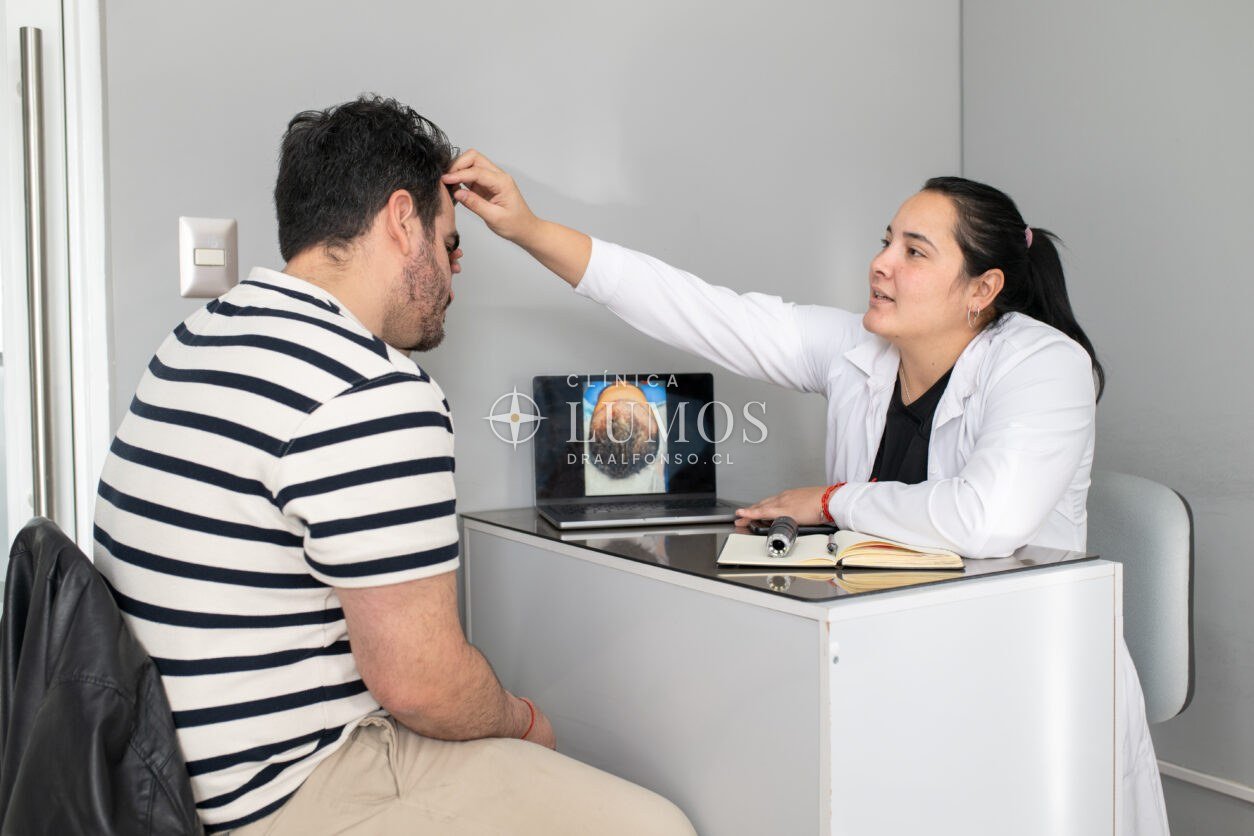
If you see more hair than normal for weeks, the important thing is to find the cause. Read what to do if you see hair in the shower or book a trichoscopy with Dr. Alfonso in Viña del Mar.
Frequently asked questions
What is the ideal temperature for washing your hair?
Lukewarm water that feels pleasant on the skin and does not leave it red. If you get out of the shower with a tight or itchy scalp, the water is probably too hot.
Does hot water worsen androgenetic alopecia?
It does not change its course, because that type of alopecia depends on genetics and hormones. It can, however, dry out the scalp and make hair more fragile.
Can I shower with hot water if I have seborrheic dermatitis?
It is better to use lukewarm water, because heat can increase irritation and itching. Treatment for dermatitis should be prescribed by a doctor.
I had a hair transplant. Can I use hot water?
Not in the first weeks. Lukewarm water is recommended, with no direct stream on the grafts and following the washing protocol you were given.
How often should I wash my hair?
It depends on your scalp: some people need to wash it daily and others don’t. What matters is keeping it clean, with a mild shampoo and without very hot water.
In summary
Hot water does not cause baldness, but it can dry out and irritate the scalp and make hair more fragile. It is best to wash with lukewarm water, massage gently and not overuse the heat of the hair dryer or flat iron. If the shedding lasts for weeks or you see changes in your density, what you need is a diagnosis, not a change in shower temperature. At Clínica Lumos, Dr. Evelyn Alfonso evaluates you personally with AI-powered trichoscopy. Book your evaluation.
This information is educational and does not replace a medical evaluation.
Trasplante Capilar y Liposucción en Viña del Mar, Valparaiso
Keep reading
Most read
RELATED POSTS
View all

Hair transplant: what the immediate result looks like and what comes next
October 23, 2026 | by Dra. Evelyn Alfonso
Can hair density be improved without a transplant?
October 23, 2026 | by Dra. Evelyn Alfonso

Where are we? Hair clinic in Viña del Mar: address, hours and how to get here
October 16, 2026 | by Dra. Evelyn Alfonso
Comments (0)
No comments yet. Be the first to ask!