

Can hair density be improved without a transplant?
October 23, 2026 | by Dra. Evelyn Alfonso

Can hair density be improved without a transplant?
October 23, 2026 · By Dr. Evelyn Alfonso
Not every case needs surgery. In some cases it is indeed possible to improve hair density without a transplant, when there are still active follicles that can be strengthened.
When you start to notice your hair getting thinner, your part getting wider, or your scalp more visible in certain lighting, it is easy to think that the only way out is a transplant. But that is not always the case. If the follicles are still alive, even if weakened, there are treatments that can help strengthen them. In this article we explain when a non-surgical treatment makes sense, how the decision is made, what tools exist, and what expectations are realistic.
A real case
This patient shows her progress after 3 months of hair protocols and personalized medication, prescribed according to her diagnosis and with professional follow-up.
Every case is different: what works for one person is not necessarily right for another. That is why this example is not a promise, but a sample of what can be achieved when treatment is based on a precise diagnosis and followed consistently.
Why hair loses density
Hair density depends on two things: how many follicles produce hair and how thick each hair is. In androgenetic alopecia, the most common form of hair loss, sensitive follicles gradually miniaturize: with each cycle they produce a finer, shorter hair. The number of follicles may stay the same for a while, but the visible volume decreases. That stage, in which the follicle is weakened but active, is precisely the one that can be best taken advantage of with treatment.
There are also other causes of density loss, such as telogen effluvium, which can appear after an illness, a period of stress, hormonal changes, strict diets, or nutritional deficiencies. In these cases, identifying and correcting the cause is a fundamental part of treatment. If you don’t know whether what you have is normal, see when hair loss is normal and when it is alopecia.
First, the diagnosis
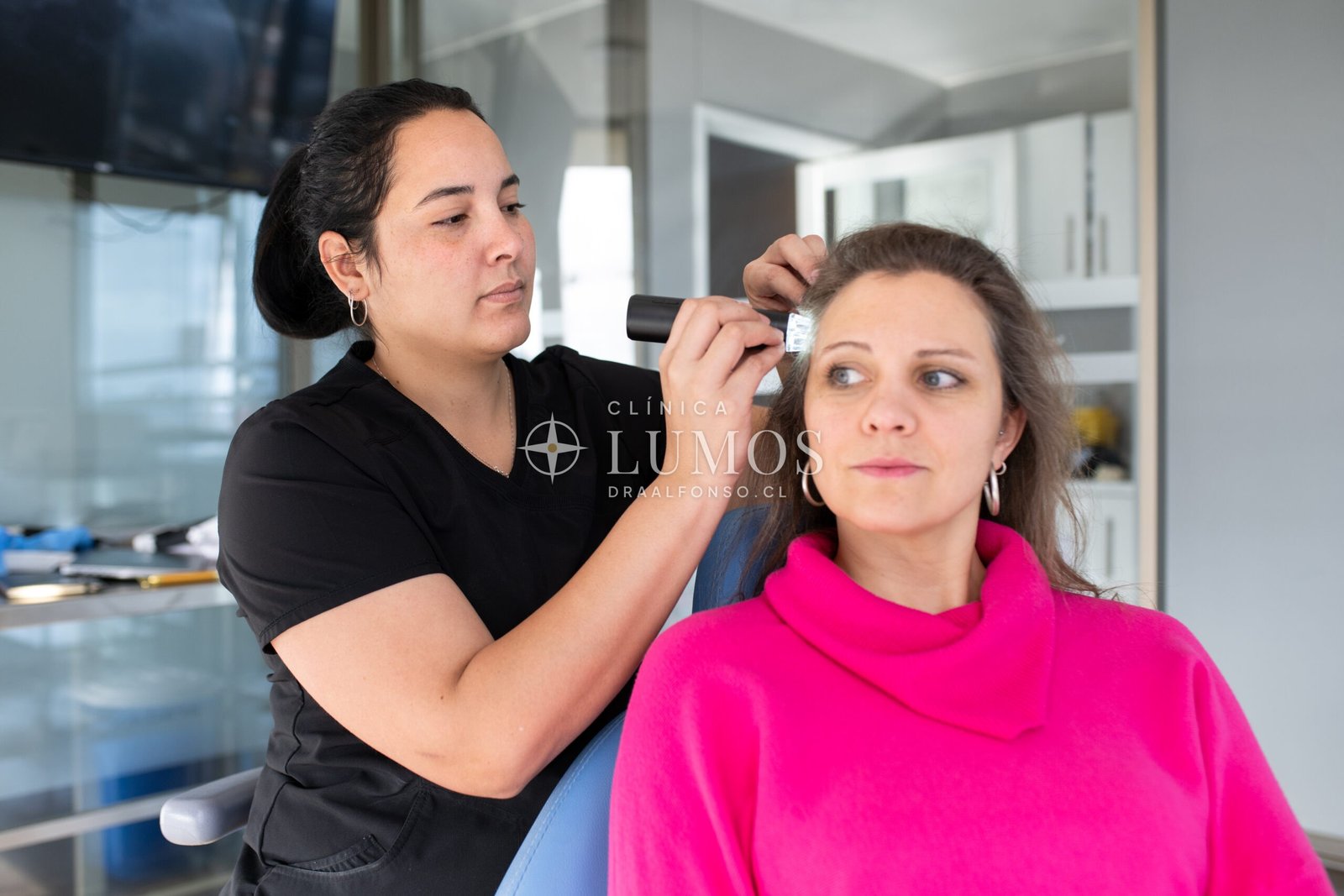
Every scalp needs a different treatment. With the Lumos Precision Hair Protocol we evaluate the factors that affect the health of your hair: trichoscopy with artificial intelligence, density measurement and, when appropriate, blood tests.
Trichoscopy lets us see what is not noticeable to the naked eye: the proportion of fine hairs, signs of miniaturization, the condition of the scalp, and the density in different areas. That information helps decide on the treatment and also serves as a starting point for comparison at follow-up visits. That way you don’t depend only on how you look in the mirror, which can vary with the lighting or your hairstyle.
The tools
- Medication prescribed by the doctor according to your type of alopecia.
- In-clinic hair protocols: follicular nutrition, growth factors, and scalp stimulation.
- Hair exosomes, which can be incorporated into personalized protocols for scalp care and maintenance. This is a developing field: we prescribe them case by case.
These tools are not used as a fixed recipe. The doctor combines those that make sense in your case, sets the frequency, and adjusts the plan according to how you respond. Any hair medication must be prescribed and monitored by a physician, because each one has indications, contraindications, and possible effects that need to be evaluated.
What the treatment is like, step by step
1. Initial evaluation
Dr. Evelyn Alfonso reviews your history, examines your scalp, and performs the trichoscopy. If necessary, tests are ordered to rule out causes that require a different approach.
2. Personalized plan
We define which combination of treatments is right for you, how often you will come to the clinic, and what you will need to do at home.
3. Treatment phase
The first weeks are about consistency. The hair cycle is slow, so changes do not show from one day to the next. It is common not to notice big differences at the start, and that does not mean the treatment is not working.
4. Follow-ups and adjustments
At follow-up visits, progress is compared with the starting point, ideally with standardized photos and trichoscopy. Depending on the response, the plan may be kept or adjusted.
5. Maintenance
Once an improvement is achieved, the goal becomes preserving it. In androgenetic alopecia, if treatment is stopped, hair loss tends to resume its course.
Maintenance matters too
You don’t always have to wait until you notice changes to start taking care of your hair. And if you have already had a transplant, the protocol helps protect your native hair.
Results depend on the diagnosis, the individual response, and consistency with the treatment. Learn about the Hair Protocol.
What expectations are realistic
Talking honestly about results is part of good treatment. A non-surgical protocol can help hair look thicker, reduce shedding, and improve coverage in areas where the follicles are still active. What it cannot do is create follicles where they no longer exist or guarantee the same result for everyone.
That is why, instead of promising you a number of hairs or a percentage of improvement, at Lumos we prefer to measure your starting point and compare your progress against yourself, visit by visit. That way you can see with concrete data whether the plan is working and make informed decisions.
What influences the response to treatment
- The type of alopecia: not all types respond the same way or are treated the same way.
- How long it has been progressing: the more active follicles remain, the more room there is to strengthen them.
- Consistency: skipping sessions or abandoning the at-home treatment limits the results.
- Your general health: nutritional deficiencies, hormonal imbalances, or periods of intense stress can have an influence and, when appropriate, are investigated.
- Individual response: two people with the same diagnosis can progress differently.
When it does make sense to consider a transplant
Non-surgical treatment works on follicles that still exist. If an area has already lost its follicles, for example with very advanced receding temples or a crown that has been thin for years, medical treatment is unlikely to make hair grow there again. In those cases, an FUE hair transplant may be an alternative, ideally combined with treatment to care for the hair you still have. If you want to know whether you are a candidate, read who is a candidate for a hair transplant.
Tips to boost your treatment
- Be consistent: most hair treatments take months to show changes.
- Take photos in the same lighting and in the same position from time to time.
- Take care of your diet and rest: they don’t replace treatment, but they help scalp health.
- Avoid pulling and excessive heat: very tight hairstyles or heavy use of flat irons can damage hair.
- Don’t combine products on your own without consulting the doctor.
Common myths
“If my hair is falling out, there is nothing to be done without surgery”
False in many cases. As long as there are active follicles, there are options to strengthen them.
“A good shampoo is enough”
A suitable shampoo helps keep the scalp clean and comfortable, but on its own it does not treat alopecia.
“If I stop treatment, all my hair falls out at once”
It does not all fall out at once, but in androgenetic alopecia hair loss usually resumes its course over time. That is why we talk about maintenance.
How to know if it is a good time to get treatment
A useful sign is the texture of the hair: if you notice that the hairs in the affected area are finer and shorter than those at the back of the head, there are probably miniaturized follicles that can still respond. Another sign is time: if the changes started recently, there is generally more room than if the area has been thin for many years. In any case, the only way to know for sure is an evaluation with trichoscopy. The sooner you have it, the more options you will have to choose from.
When to seek a consultation
Seek a consultation if you notice your hair is thinner, if you see more scalp than before, if the shedding continues for several weeks, or if it appears suddenly, in patches, or accompanied by itching, pain, or flaking.
Frequently asked questions
How long does it take to notice an improvement?
It depends on each person and on the prescribed treatment. Since the hair cycle is slow, changes are usually evaluated after several months of consistency, as in the 3-month case we showed.
Does the treatment work for men and women?
Yes, although the diagnosis and the options may be different. In women a broader workup is often done. See our article on alopecia in women.
What are hair exosomes?
They are a tool that can be incorporated into personalized protocols for scalp care. It is a developing field, so they are prescribed case by case and not as a stand-alone treatment.
Do I absolutely have to take medication?
Not necessarily. The doctor will evaluate whether medication is right for you, considering your diagnosis, your history, and your preferences.
Can I do the protocol if I have already had a transplant?
Yes. In fact, it helps protect the native hair surrounding the transplanted area, which helps the result stay harmonious.
In summary
If you still have active follicles, it is often possible to improve density without surgery, with a precise diagnosis, a personalized plan, and consistency. And if there are already areas without follicles, a transplant can complement the treatment. To find out where you stand, book your evaluation with Dr. Alfonso in Viña del Mar.
Educational information. It does not replace a medical evaluation. Results vary from patient to patient.
Keep reading
Most read
RELATED POSTS
View all


Am I a candidate for a hair transplant? Signs, age and realistic expectations
October 16, 2026 | by Dra. Evelyn Alfonso

Does a Hair Transplant Fall Out? Is It Long-Lasting?
October 23, 2026 | by Dra. Evelyn Alfonso
Comments (0)
No comments yet. Be the first to ask!