

What really happens on the day of your hair transplant
October 23, 2026 | by Dra. Evelyn Alfonso

What really happens on the day of your hair transplant
October 23, 2026 · By Dr. Evelyn Alfonso
What really happens on the day of your hair transplant? The success of an implant lies in the details and in experience. Dr. Alfonso shows you step by step:
It is completely normal to feel nervous before surgery, even when it is outpatient and done under local anesthesia. Much of that anxiety comes from not knowing what is going to happen. That is why here we tell you what the day is like, from the moment you arrive at the clinic until you go back home, what you will feel, how to prepare in the days before, and what care to take in the first hours. That way you arrive calm, informed, and knowing what to expect.
Before the big day: preparation
Preparation for transplant day begins weeks in advance. First comes the evaluation, where Dr. Evelyn Alfonso personally reviews your type of alopecia, your donor area, and your expectations, and the plan is defined. Then come the pre-operative tests, which you can take at the clinic itself, to confirm that you are fit to undergo surgery safely.
In the days before, the team will give you specific instructions. In general, they usually include:
- Reporting all the medications and supplements you take, because some may need to be temporarily stopped as directed by your doctor.
- Avoiding alcohol in the days beforehand and, if you smoke, talking with the doctor about quitting or cutting back, since smoking affects circulation and healing. Read more about smoking before surgery.
- Getting a good night’s sleep the night before and eating a light breakfast, unless you are told otherwise.
- Arriving with clean hair and comfortable clothes, ideally a shirt or hoodie that opens in the front, so you don’t have to pull anything over your head when you leave.
- Arranging for someone to accompany you home, because you should not drive after the procedure.
The day, step by step
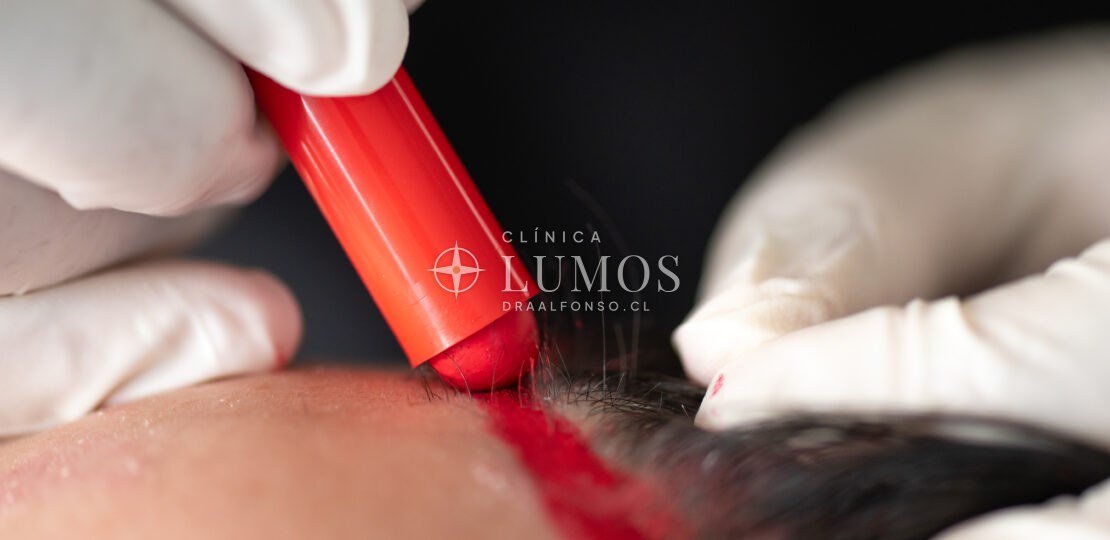
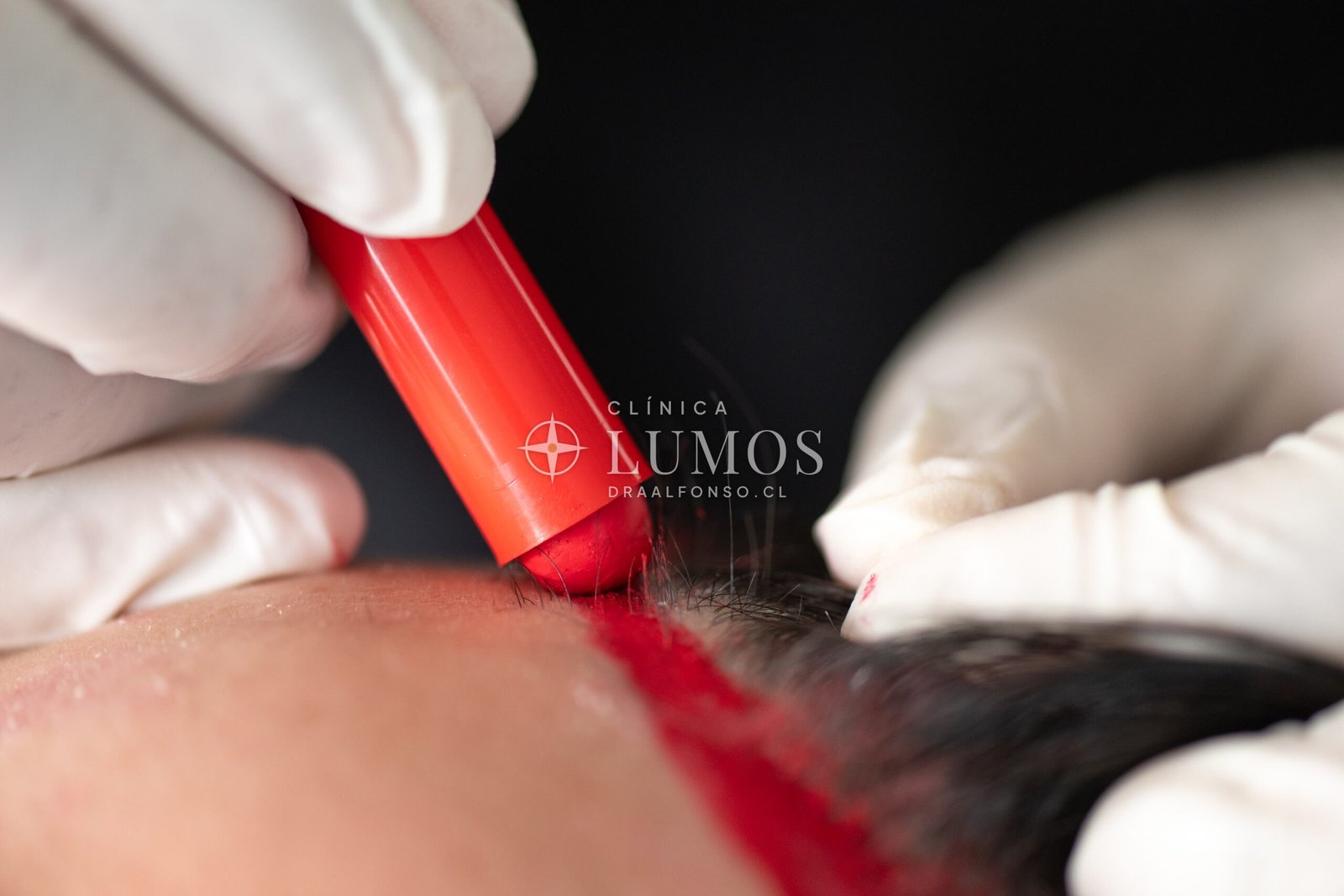
1. Hairline design
We do it together, in front of the mirror, so you can see how you will look in real life. Nothing is implanted until you approve the design.
This moment is key. The frontal hairline is drawn taking into account the proportions of your face, your age, and how your alopecia could evolve in the future. This is the time to ask anything you want: how low the hairline will be, how the temples will look, which areas will have priority. A good design does not just aim to cover, but to look natural today and for many years to come.
2. Extraction with the FUE technique
Local anesthesia is applied to the donor area, usually the back of the head, and the follicles are extracted one by one with maximum precision.
The local anesthesia is usually the only part that is a little uncomfortable: you feel small pricks at first, and then the area goes numb. During the extraction you are awake and can talk, listen to music, or rest. The extracted follicles are handled carefully and kept in suitable conditions until they are implanted, because every one counts.
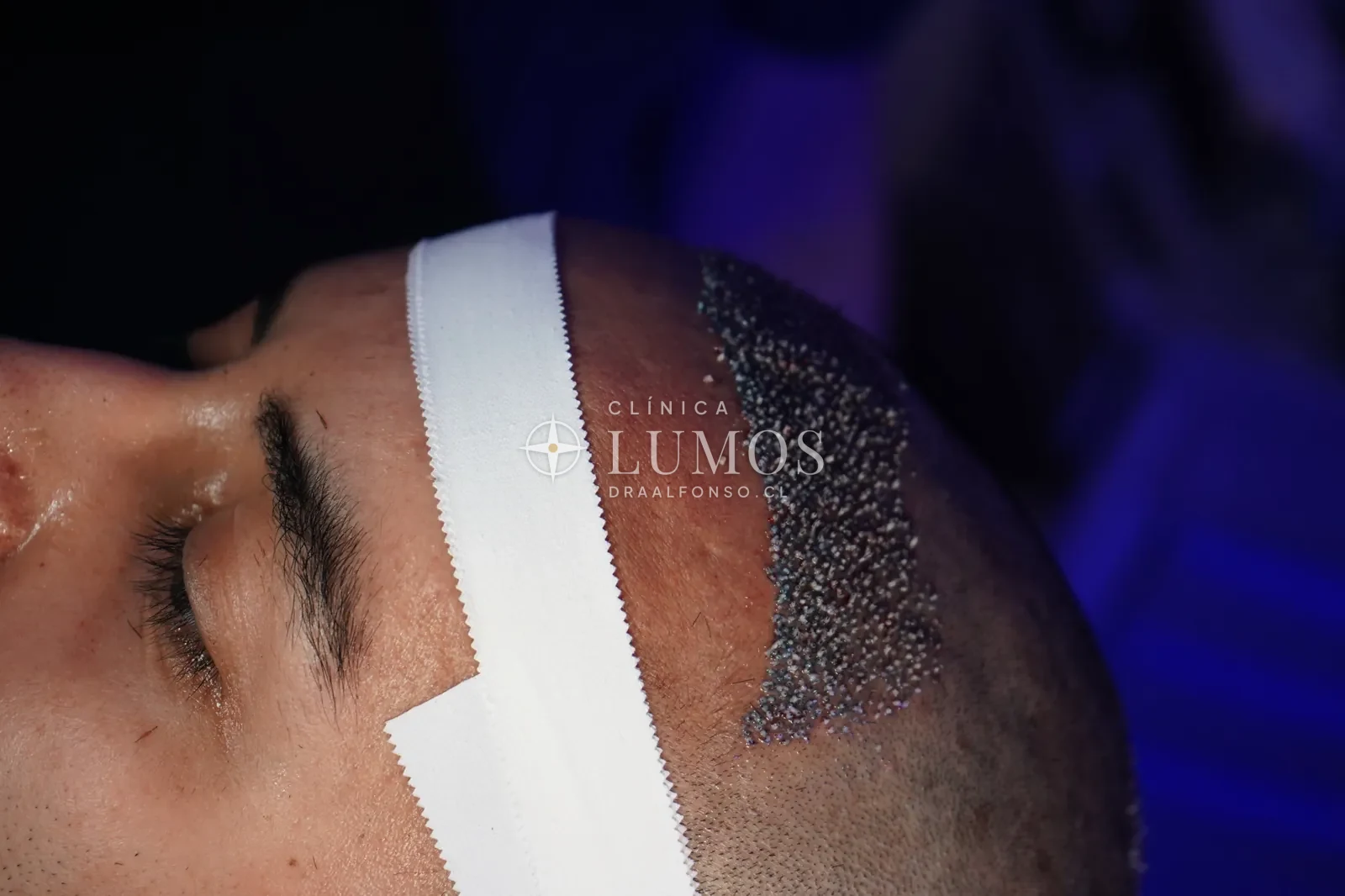
3. Implantation
This is the most delicate phase: taking care of the angle, direction, and density of each follicle is what determines whether the result will look natural.
Before implanting, the recipient area is also anesthetized. The follicles are then placed following the direction in which hair naturally grows in each area: along the frontal hairline, finer follicles are usually preferred to achieve a soft transition, and further back greater density is sought. It is meticulous work that requires concentration and experience.
4. Same-day discharge
It is an outpatient surgery: you are discharged the same day to rest at home, accompanied and without driving.
Before you leave, you will receive instructions for the first hours and days: how to sleep, how to protect the implanted area, when and how the first wash will be, and what medications to take if the doctor prescribes them. And you don’t leave with just a piece of paper: throughout the treatment you have direct contact via WhatsApp to answer any questions.
What to bring that day
- Your ID and any tests or reports you have been asked for.
- The list of medications you usually take.
- Comfortable, warm clothes, with a garment that opens in the front.
- Something to keep you entertained during breaks: headphones, music, or a podcast.
- The contact details of the person who will accompany you home.
If you are coming from Santiago or another city, plan your trip in advance so you arrive without rushing. Arriving relaxed makes a difference in how you experience the day.
How the team supports you throughout the day
A hair transplant is teamwork, but with one clear person in charge: the doctor who designs, plans, and leads the procedure. During the day, the team checks how you are feeling, monitors your comfort, and lets you know at each stage what comes next. You don’t have to guess anything: if something bothers you, if you need a break, or if you have a question, you can say so at any time. Knowing there is a familiar face in charge of your case, from the evaluation to the follow-up visits, is usually very reassuring.
Does a hair transplant hurt?
This is one of the most frequently asked questions. Most of the discomfort is concentrated at the moment the local anesthesia is applied. Once it takes effect, the procedure is usually well tolerated. After surgery there may be a feeling of tightness, sensitivity at the back of the head, or some swelling on the forehead during the first few days, which is normally managed by following medical instructions. Everyone experiences it differently, and the team will pay attention to how you feel throughout the day.
The first 72 hours at home
- Protect the implanted area: avoid rubbing, bumps, and touching the follicles. They are very delicate in the first few days.
- Sleep semi-upright or with your head elevated, as instructed, to help reduce swelling.
- Don’t do intense exercise or activities that make you sweat a lot until the doctor gives you the go-ahead.
- Follow the washing instructions to the letter. See how to wash your head after a hair transplant.
- Avoid direct sun on the scalp and don’t wear tight hats unless instructed to.
- Avoid alcohol and smoking during recovery.
What comes next: the progression
Transplant day is just the beginning. In the first few days, small scabs appear that come off with washing. Between weeks 2 and 4 it is normal for the implanted hair to fall out: the follicle remains and will produce hair again. New growth usually begins from 3 to 4 months, and the final result can be seen between 10 and 12 months. You can read more about the progression after a transplant and about shock loss, a temporary shedding that can affect native hair.
The most important thing
A hair transplant is not something to improvise or delegate to a technician: it must be in the hands of medical professionals. Read what to check when choosing where to have surgery and learn about FUE hair transplant in Viña del Mar.
At Clínica Lumos, Dr. Evelyn Alfonso, trained in the FUE technique in Turkey, Italy, and Barcelona, leads every procedure, which is performed in an operating room authorized by the SEREMI de Salud (regional health authority). The clinic is in Viña del Mar, about an hour and a half from Santiago, which allows many patients from the capital to come and go back the same day with a companion.
Myths about transplant day
“They put you completely to sleep”
FUE hair transplant is usually performed under local anesthesia. You are awake and can communicate with the team at all times.
“You leave with the final result”
You leave with the follicles implanted, but the transplanted hair falls out in the first few weeks and the definitive result is seen over the months.
“The next day you can go about your normal life without any care”
Many people resume light activities within a few days, but the first few days require specific care to protect the follicles.
Signs to seek advice after surgery
After discharge it is normal to have some sensitivity and swelling, but there are signs you should not ignore. Contact the team if you notice bleeding that does not stop with gentle pressure, pain that increases instead of decreasing, widespread redness, discharge, fever, or any symptom that worries you. It is better to ask in time.
Frequently asked questions
How long does the procedure take?
It depends on the number of follicles to be implanted and on each case. In general it is a procedure that takes several hours, so it is a good idea to set aside the whole day. At your evaluation you will be given an estimate based on your plan.
Can I eat during surgery?
Since it is a long day, breaks to rest and hydrate are usually planned. The team will tell you how the day is organized.
Do I need to shave my head?
It depends on the technique and the case. There is the option of a hair transplant without shaving for those looking for more discretion; the doctor will tell you whether it is suitable for you.
When can I go back to work?
It depends on your type of work and how much you mind it being noticeable. Many people with office jobs return within a few days; demanding physical activities require more time. You will discuss it with the doctor according to your case.
Can I go to the surgery alone?
You can arrive alone, but it is important that someone accompanies you home and that you don’t drive that day.
In summary
Transplant day is divided into four moments: design, extraction, implantation, and discharge. With good preparation, local anesthesia, and an attentive medical team, most patients experience it with more calm than they expected. What follows is patience and care. If you want to know what your day would be like, book your evaluation with Dr. Alfonso.
Educational information. It does not replace a medical evaluation. Results vary from patient to patient.
Keep reading
Most read
RELATED POSTS
View all

Can hair density be improved without a transplant?
October 23, 2026 | by Dra. Evelyn Alfonso


How to choose a hair transplant clinic in Chile: 10 questions to ask before surgery
October 24, 2026 | by Dra. Evelyn Alfonso
Comments (0)
No comments yet. Be the first to ask!