

Female hair transplant: a case one year after the procedure
October 23, 2026 | by Dra. Evelyn Alfonso
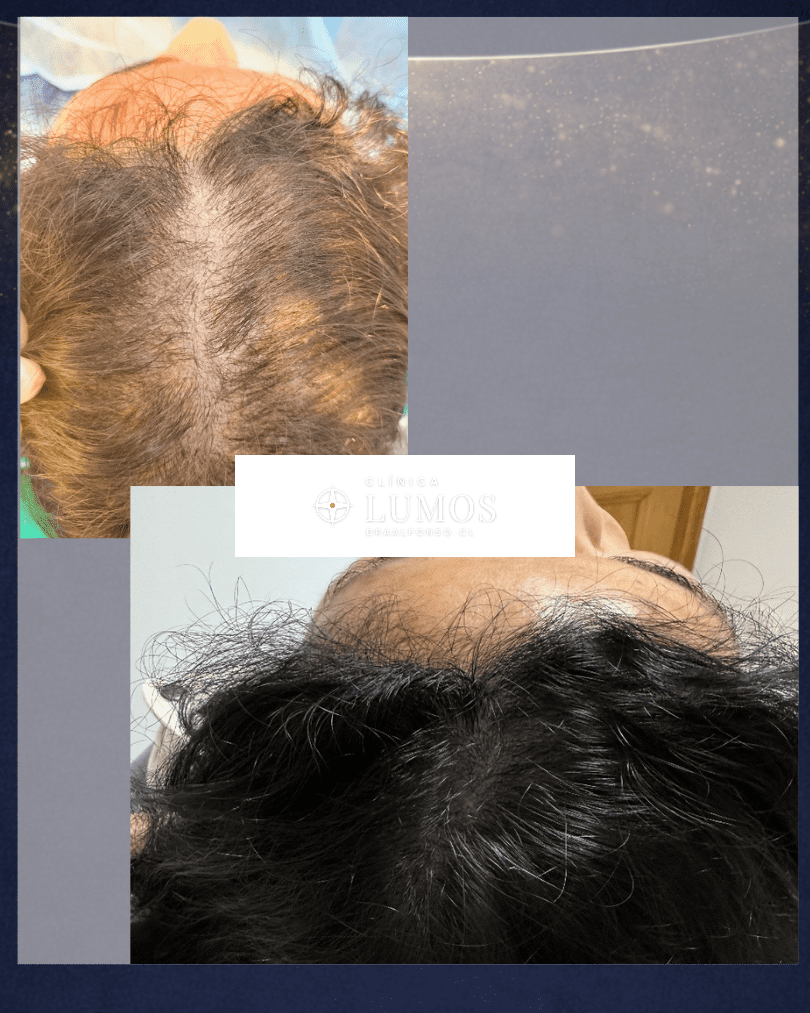

Female hair transplant: a case one year after the procedure
October 23, 2026 · By Dr. Evelyn Alfonso
Every hair transplant begins long before implant day. In this case we designed a completely personalized plan for our patient.
For many women, hair loss is a silent experience. It shows in a part that keeps getting wider, a thinner ponytail, or a scalp that shows through under a camera flash. And although it is much more common than people think, it is still rarely talked about. In this article we tell you how we approached this case, why diagnosis is so important in women, when a transplant can be an option, and what alternatives exist when it is not.
The plan
- Detailed evaluation of the type of alopecia and the donor area.
- Prior hair treatment to optimize scalp health.
- Individualized transplant planning, respecting the anatomy and characteristics of her hair.
The result
One year after the procedure, the patient has a natural result, with greater density and hair that is once again part of her everyday life.
A great result does not depend only on the surgery, but on comprehensive support before, during, and after.
More than a cosmetic matter
Hair loss in women is often experienced with a heavy emotional burden. Many patients tell us they changed the way they style their hair to hide their part, that they avoid photos in strong light, or that they feel uncomfortable on windy or rainy days. Some spend years trying products on their own before seeking a consultation. All of that is understandable, and it is also a reason not to wait: a consultation does not commit you to surgery, but it does give you a diagnosis and a clear path.
At the consultation we want you to feel heard. There are no silly questions or exaggerated concerns: understanding how hair loss affects you is part of designing a plan that makes sense for you.
Why female alopecia is different
In men, androgenetic alopecia usually follows a recognizable pattern: receding temples, mid-scalp, and crown. In women, on the other hand, the frontal hairline is often preserved and the loss is more diffuse, concentrated on the top of the head. In addition, female hair loss can be related to multiple factors: genetic predisposition, hormonal changes such as postpartum or menopause, thyroid disorders, nutritional deficiencies, stress, or certain medications. Often more than one cause coexists.
This has a practical consequence: before thinking about surgery, you need to understand clearly what is happening. If the hair loss has a treatable cause, addressing it can completely change the plan. And if the alopecia is still active, operating without treating it could produce a result that does not hold up over time. You can read more in our article on alopecia in women.
When a transplant is an option for women
In women, a transplant is indicated in selected cases, with stable alopecia and a good donor area. In general terms, that means:
- The hair loss is controlled or stable, ideally after a period of treatment and follow-up.
- The donor area, usually the back of the head, has good density and does not show the same thinning as the top.
- There are defined areas where increased density will have a visible impact, such as the part, the front, or the temples.
- Expectations are realistic and have been discussed clearly.
When the loss is very diffuse and also affects the donor area, a transplant may not be the best alternative, and in those cases the focus is usually on medical treatment and hair protocols.
The donor area in women: why it is studied so closely
In a transplant, follicles are usually taken from the back of the head, because in many people that area is more resistant to alopecia. In some women, however, diffuse loss also affects that area. If the donor area is weakened, the transplanted follicles might not behave as expected, and the extraction could leave that area with lower visible density. That is why, in women, special attention is paid to measuring the density and thickness of the hair at the back of the head before deciding. It is one of the factors that carries the most weight in the indication.
How to prepare for your consultation
- Write down when you started noticing the hair loss and whether it coincided with any change: a pregnancy, an illness, a period of stress, or a change in medication.
- Bring any recent tests you have.
- Make a list of the products and treatments you have tried.
- If you have old photos that show your hair, bring them: they help gauge the change.
- Think about what you would like to improve first: the part, the front, the overall volume.
The process, step by step
1. Evaluation and diagnosis
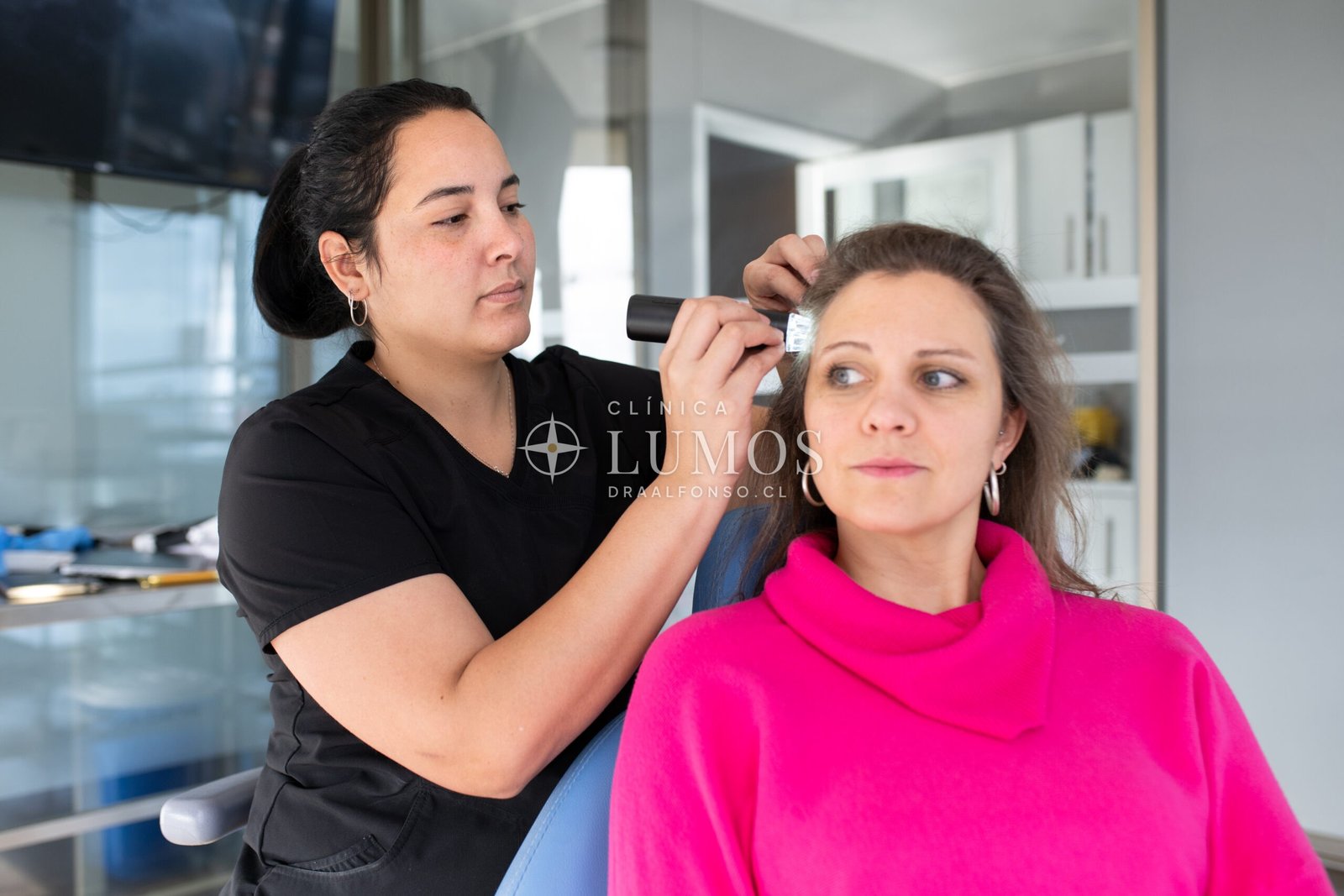
Dr. Evelyn Alfonso personally evaluates each case. We talk about the history of the hair loss, family history, cycles, pregnancies, medications, and other factors. With trichoscopy with artificial intelligence, the density and thickness of the hair are analyzed in different areas, including the donor area. When appropriate, blood tests are ordered.
2. Prior treatment
As in this case, hair treatment is often prescribed before surgery to optimize scalp health and stabilize hair loss. A Hair Protocol can be part of this stage. Any medication must be prescribed by the doctor according to the diagnosis.
3. Transplant planning
We define where the density will be concentrated, how many follicles it is reasonable to extract, and how to respect the natural shape of the patient’s hair: its direction, its texture, and the way she usually styles it.
4. The procedure
It is performed with the FUE technique, under local anesthesia, in an operating room authorized by the SEREMI de Salud (regional health authority). Many women prefer not to shave their hair; the option of a transplant without shaving can be evaluated case by case.
5. Recovery and progression
As with any transplant, the implanted hair usually falls out during the first few weeks, starts to grow from 3 to 4 months, and the result can be seen at around one year. In some cases shock loss may appear, a temporary shedding of nearby native hair. Throughout the treatment there is direct contact via WhatsApp.
Why support makes the difference
In this case, the result is not explained only by what happened in the operating room. It is explained by a sequence: diagnosing well, preparing the scalp, planning carefully, operating with precision, and supporting the recovery. If any of those steps is missing, the result can suffer. That is why at Clínica Lumos the same doctor who evaluates you is the one who leads the procedure and follows your progress, and during treatment you can write directly via WhatsApp whenever you have questions. Coming from Santiago is also possible: the clinic is in Viña del Mar, about an hour and a half away.
Tips if you notice your hair is getting thinner
- Don’t normalize it without a consultation: hair loss that persists over time deserves an evaluation.
- Record the changes: photos of your part in the same lighting from time to time help you see the real progression.
- Protect your hair from traction: very tight hairstyles, extensions, or tight buns can damage it.
- Be careful with heat and chemicals: frequent use of flat irons or harsh treatments can weaken the hair shaft.
- Don’t self-medicate: alopecia treatments must be prescribed by a physician, especially if you are pregnant, breastfeeding, or planning a pregnancy.
Myths about female hair transplant
“Hair transplants are only for men”
No. Women can also be candidates, although in selected cases and after a careful diagnosis.
“I have to shave my head”
Not necessarily. There are alternatives without full shaving that are evaluated case by case.
“If I have surgery, I no longer need treatment”
In many cases, treating the native hair remains important to keep the result harmonious over time.
When to seek a consultation
- Your part looks wider and wider or your scalp shows through.
- Your ponytail is noticeably thinner than before.
- The hair loss continues for several weeks or appears suddenly.
- There is itching, pain, redness, or bald patches.
- The hair loss is accompanied by other symptoms, such as changes in your cycle, fatigue, or weight changes.
Frequently asked questions
How do I know if I am a candidate for a transplant?
Only a medical evaluation can answer that. The type of alopecia, whether it is stable, and the quality of your donor area are analyzed. Also see who is a candidate for a hair transplant.
Does the result look natural in women?
When the case is well selected and the planning respects the direction and texture of the hair, the goal is a natural result, as in this patient one year later. Results vary from person to person.
Can I dye my hair after the transplant?
Yes, but it is best to wait as long as the doctor indicates before applying dyes or chemicals to the scalp.
What happens if I am not a candidate?
There are non-surgical options to strengthen active follicles. Read how to improve hair density without a transplant.
How long does it take to see the result?
New hair starts to grow from 3 to 4 months, and the result can be seen between 10 and 12 months, as in the case of this patient, evaluated at one year.
In summary
In women, a hair transplant can be a great tool in selected cases, with stable alopecia and a good donor area, and always within a comprehensive plan that includes diagnosis, prior treatment, and follow-up. Learn how we treat female alopecia and about the transplant without shaving. If you want to know what options you have, book your evaluation with Dr. Alfonso.
Educational information. It does not replace a medical evaluation. Results vary from patient to patient.
Keep reading
Most read
RELATED POSTS
View all


How to Wash Your Head After a Hair Transplant, Step by Step
October 23, 2026 | by Dra. Evelyn Alfonso
Seeing hair in the shower or bathroom? What to do if your hair is falling out
October 23, 2026 | by Dra. Evelyn Alfonso
Comments (0)
No comments yet. Be the first to ask!