

Where are you losing the most hair? Alopecia patterns
October 23, 2026 | by Dra. Evelyn Alfonso

Where are you losing the most hair? Alopecia patterns
October 23, 2026 · By Dr. Evelyn Alfonso

Hair loss does not look the same in every patient. It can start at the hairline, progress through the mid-scalp or become noticeable at the crown.
Looking in the mirror and noticing that “something has changed” is often the first step. But it is not enough to know that you are losing hair: it also matters where you are losing it and how it is progressing. The pattern of your hair loss gives clues about the type of alopecia, helps anticipate its progression and guides which treatment makes the most sense for you. In this article we explain the most common patterns, how to recognize them and what to do in each case.
The most common patterns
- Temples and hairline: recession at the temples and of the hairline.
- Mid-scalp: loss of density on the top of the head.
- Crown (vertex): the whorl gradually thins out. Read hair loss at the crown.
- Female diffuse pattern: in women the hairline is usually preserved. See female alopecia.
Why hair is lost in specific areas
The most common form of hair loss is androgenetic alopecia, which has a hereditary and hormonal component. In predisposed people, certain follicles on the top of the head are more sensitive to the action of androgenic hormones. Over time, those follicles “miniaturize”: they produce increasingly finer, shorter and lighter hairs, until some stop producing visible hair.
In contrast, the follicles at the back and sides of the head are usually more resistant to this process. That is why, even in people with advanced alopecia, this band tends to be preserved. This is the reason it is used as the donor area in a hair transplant: follicles moved from there generally keep that resistance.
Not all hair loss follows this mechanism. There are other types of alopecia, such as effluvium (diffuse, temporary shedding that can appear after stress, illness or sudden changes), alopecia areata (round patches) or scarring alopecias, which require different management. That is why the visible pattern is only part of the diagnosis.
How to recognize each pattern
Temples and hairline
This is usually the first thing men notice. The temples begin to recede and the hairline loses its shape. A useful tip is to compare old photos with current ones, with your hair pulled back and in the same light. It is important to distinguish between normal maturation of the hairline, which can recede slightly in adulthood, and alopecia that keeps progressing.
Mid-scalp
The top of the head loses density and the scalp begins to show through, especially under overhead light or when the hair is wet. It is often noticed first in photos or when seeing yourself in an elevator mirror.
Crown
The whorl gets larger and more skin shows. Since it is an area we do not see directly, it is usually detected late, sometimes when someone else mentions it or in a photo taken from above.
Female diffuse pattern
In women the hairline is often maintained and the loss shows as an increasingly wider part or a general decrease in volume on the top of the head. It may be related to hormonal, genetic or other factors, so the work-up is usually broader.
Combined patterns
Many people do not have a single pattern: they may have receding temples and crown loss at the same time, which join together over the years. That is why it is worth looking at the whole head and not just the area that worries you most.
How patterns are classified
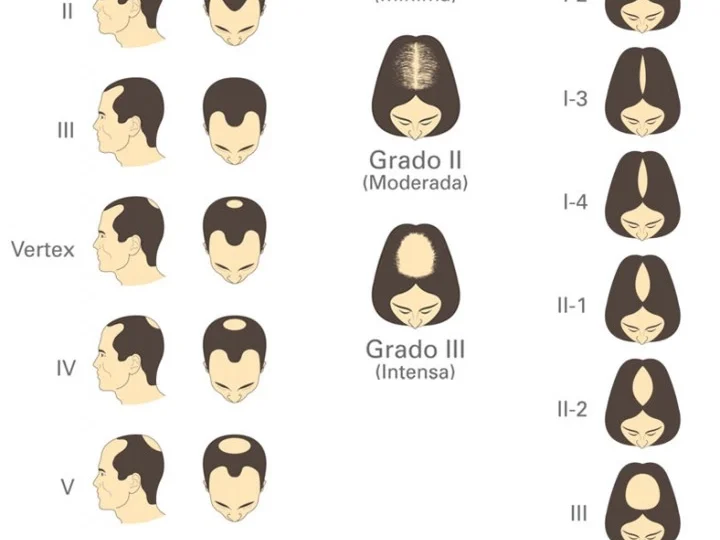
To describe alopecia systematically, doctors use classification scales. In men, the best known is the Norwood scale, which ranges from a slight recession of the temples to stages where only the side and back band remains. In women the Ludwig scale is often used, which describes the progressive widening of the part and the loss of density on the top of the head.
These scales are not a sentence or a label: they are a tool to compare your progression over time and to communicate precisely what stage you are at. Two people with the same grade can have very different needs depending on their age, the quality of their hair and their donor area.
What your pattern means if you are considering a transplant
If you are considering a hair transplant, your pattern influences several decisions:
- Hairline design: it must be planned not only for today, but for how it will look as you get older. A hairline that is too low in a young person may look out of place if alopecia keeps progressing behind it.
- Follicle distribution: the donor area is limited, so priorities must be set. Often the frame of the face is favored, since it has the greatest impact on appearance.
- Need for complementary treatment: if the pattern shows that hair loss is still active, treating native hair helps keep the result from becoming isolated over the years.
- Possibility of a second session: in extensive patterns, the possibility of a later touch-up is sometimes planned from the start.
Why identifying it matters
Your pattern, together with the quality of your donor area, defines the treatment: a Hair Protocol, a FUE hair transplant or a combination. Each case requires a precise diagnosis and a strategic design. The sooner you have your case evaluated, the more options you will have.
For example, if hair loss has just started and there are still many active follicles, it may make sense to prioritize treatment to strengthen them. If an area has already lost its follicles, medical treatment is unlikely to recover them, and that is where a transplant can be an option. And even if you have surgery, caring for your native hair is key for the result to look harmonious over the years.
How the diagnosis is made
- Clinical interview: when the hair loss started, whether there is a family history, recent health changes, medications or stress.
- Scalp examination: Dr. Evelyn Alfonso personally evaluates the affected areas and the donor area.
- Trichoscopy: using AI-assisted trichoscopy we examine hair thickness, density and signs of miniaturization.
- Complementary tests: when appropriate, blood tests are ordered to rule out other causes.
- Personalized plan: with all that information, we decide whether medical treatment, a transplant or both is advisable.
Practical tips in the meantime
- Take regular photos from the front, the sides and the crown, in the same light and with dry hair. They will help you see the real progression.
- Do not self-medicate: alopecia treatments must be prescribed by a doctor according to your diagnosis.
- Be wary of miracle solutions: no shampoo on its own reverses androgenetic alopecia.
- Take care of your general health: a balanced diet, good rest and stress management help your scalp, although they do not replace treatment.
- Do not wait too long: getting checked in time allows you to act while there are still more follicles to protect.
Myths about hair loss patterns
“If my dad isn’t bald, I won’t be either”
The inheritance of alopecia is complex and can come from both sides of the family. Not having a bald father does not rule out developing it.
“Women don’t get alopecia”
They do, although it often presents differently, more diffusely and without marked receding temples. That is why it is sometimes diagnosed later.
“Wearing a hat or washing your hair a lot causes baldness”
There is no evidence that these habits cause androgenetic alopecia. Seeing hairs in the shower is normal up to a point; what matters is whether density is decreasing.
When to get checked
- You notice your temples, your part or your crown changing from one year to the next.
- You lose hair suddenly or in patches.
- You have intense itching, pain, redness or flaking on your scalp.
- The hair loss comes with other symptoms, such as fatigue or changes in your menstrual cycle.
- You want to know whether you are a candidate for treatment or a transplant.
Learn about the types of alopecia.
Frequently asked questions
Does my hair loss pattern show how bald I will become?
It gives a guide, but it cannot accurately predict how it will progress. Age of onset, speed of progression and family history also play a role. That is why it is useful to monitor it over time.
Can any area be transplanted?
Technically the hairline, mid-scalp and crown can be treated, but the decision depends on how many follicles you have available in the donor area and how your alopecia is expected to progress. The crown, for example, usually requires special planning.
Is female alopecia treated the same way as male alopecia?
Not always. In women a broader work-up is usually done, and a transplant is indicated in selected cases, with stable alopecia and a good donor area.
Can I stop hair loss without surgery?
In many cases it is possible to strengthen follicles that are still active with medical treatment and in-clinic protocols. See how to improve hair density without a transplant.
At what age should you get evaluated?
As soon as you notice changes. Getting evaluated does not mean having surgery: it lets you know your diagnosis and act in time. If you are considering surgery, read the right age for a hair implant.
In summary
Hair loss can start at the temples, the mid-scalp, the crown or diffusely, and each pattern tells you something about your alopecia. Identifying it, along with evaluating your donor area, makes it possible to choose the right path: medical treatment, a transplant or a combination. The sooner you get it evaluated, the more options you will have. Book your evaluation with Dr. Alfonso in Viña del Mar.
Educational information. It does not replace a medical evaluation. Results vary from patient to patient.
Keep reading
Most read
RELATED POSTS
View all


How Much Does a Hair Transplant Cost in Chile? What Affects the Price
October 23, 2026 | by Dra. Evelyn Alfonso

Where does Chile rank in the world baldness ranking?
October 23, 2026 | by Dra. Evelyn Alfonso
Hair transplant: what the immediate result looks like and what comes next
October 23, 2026 | by Dra. Evelyn Alfonso
Comments (0)
No comments yet. Be the first to ask!