

Blog
Artículos de la Dra. Evelyn Alfonso sobre trasplante capilar, LipoVaser y medicina estética en Viña del Mar.
Most read
Smoking before surgery: why you should quit at least 4 weeks beforehand
October 23, 2026 | by Dra. Evelyn Alfonso

Diet before and after liposuction: what the evidence says
October 23, 2026 | by Dra. Evelyn Alfonso
Liposuction aftercare: compression garment and lymphatic drainage
October 23, 2026 | by Dra. Evelyn Alfonso
Hair Loss on the Crown: Causes and Treatment
October 23, 2026 | by Dra. Evelyn Alfonso
Shock Loss: Temporary Shedding After a Hair Transplant
October 23, 2026 | by Dra. Evelyn Alfonso
Hair Transplant in Chile or Turkey? What You Should Consider
October 23, 2026 | by Dra. Evelyn Alfonso
How Much Does a Hair Transplant Cost in Chile? What Affects the Price
October 23, 2026 | by Dra. Evelyn Alfonso



At What Age Can I Get a Hair Transplant?
October 23, 2026 · By Dr. Evelyn Alfonso
Many young people ask us if they can have surgery yet, and older patients also ask us whether “it’s too late.” The answer depends less on age and more on the state of your hair loss and your donor area.
In this article we explain why there is no perfect age, what the risks of having surgery too early are, what is evaluated in older patients, and what you can do while the right time comes.
Is there a minimum age?
Hair transplants are for adults. But in young patients, the general recommendation is to wait for the hair loss to stabilize, which usually happens around age 25.
Why? If you have surgery too early, hair loss keeps progressing around the implanted area: for example, the receding temples are filled in, but years later it is the crown that thins out. That can require a second procedure.
The problem of hair “islands”
Transplanted hair comes from the donor area —the back and sides of the head—, which is resistant to androgenetic alopecia. That is why it stays. The native hair around it, however, may keep falling out. If a dense hairline is implanted at age 20 and the hair loss continues, over time you may be left with a strip of hair in front and a thinned area behind it, something that looks unnatural and is difficult to correct.
The donor area is limited
Each person has a finite number of follicles that can be extracted without the donor area looking thin. If many are used in a first surgery at a young age, fewer are left to cover the areas lost later. Planning well means thinking about how many follicles you will need over your whole life, not just today.
Expectations at age 20
At that age, people often want to recover their teenage hairline. A good design, however, thinks about how your face will look at 40 or 50. A slightly higher hairline with natural irregularities ages much better.
So what do I do in the meantime?
Waiting does not mean sitting on your hands. This stage is key to preserving the hair you have:
- A trichoscopy to measure your hair loss and track it with data.
- A Hair Protocol to slow hair loss and strengthen your hair while the right time comes.
- Medical treatments prescribed by a specialist. There are drugs with good evidence for androgenetic alopecia, but they must be prescribed and monitored by a doctor according to your case.
- Regular check-ups to compare photographs and measurements and know whether the hair loss is stabilizing.
Many young patients who come in thinking about surgery discover that, with timely treatment, they recover enough density to postpone it for several years, or that when they do have surgery they need fewer follicles.
Is there a maximum age?
No. Patients aged 60 or 70 can perfectly well have surgery if they are in good health and have enough follicles in the donor area. In fact, in older patients the hair loss pattern is already stable, which allows for a more predictable design.
What is evaluated carefully is general health: for example, blood pressure or diabetes must be under control. Pre-operative tests can be done at the clinic.
What changes with age
- The donor area: over the years, the hair on the nape and sides can also thin. You need to measure how much usable hair is left.
- Thickness and color: gray or very fine hair covers differently. The design is adapted to achieve a natural effect.
- Medications: some, such as anticoagulants, may require adjustments coordinated with your treating physician. Never stop a medication on your own.
- Recovery: it is usually very similar to that of a young patient if health is under control.
Age and type of alopecia: it is not the same in men and women
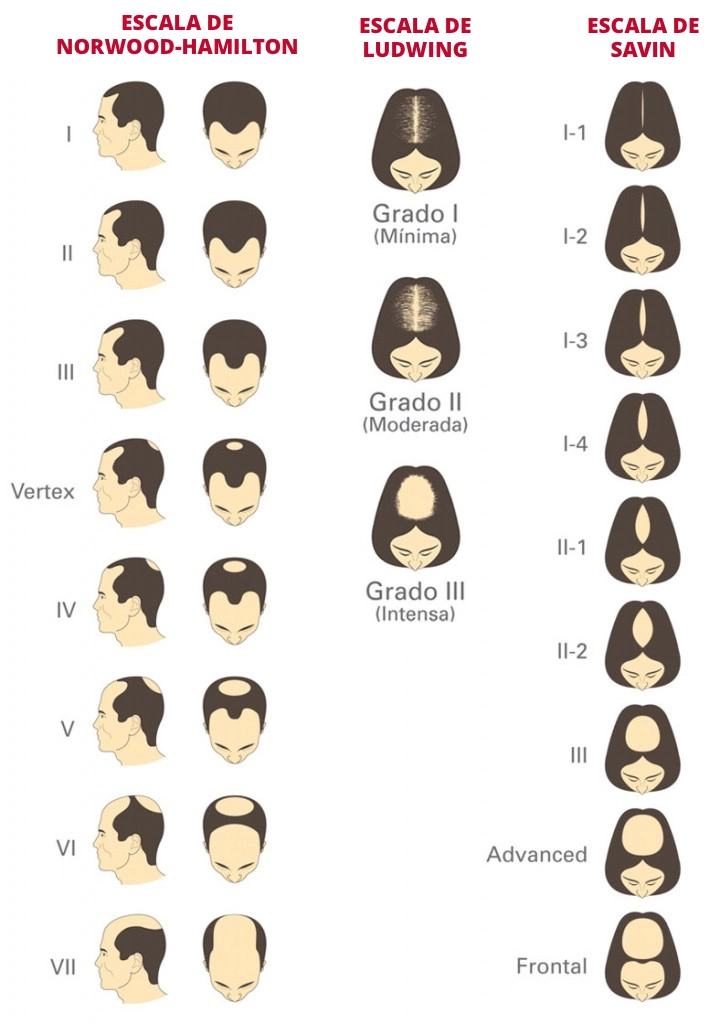
In men, androgenetic alopecia usually follows a pattern of receding temples and crown, which is classified into grades. The clearer and more stable that pattern is, the easier it is to plan.
In women, hair loss is usually more diffuse, with thinning across the entire top of the head. In addition, hormonal changes such as postpartum or menopause can influence hair loss. That is why, in women, a prior diagnosis is even more important: not all are candidates for surgery, and many respond very well to medical treatments. Learn about the types of alopecia.
What really decides
- The type and stability of your hair loss.
- The quality of your donor area.
- Your general health.
- Your expectations.
In other words: a 23-year-old patient with slow, stable hair loss and a good donor area may be a better candidate than a 35-year-old with very active hair loss. Age is a guide, but the diagnosis decides.
That is why, when a patient asks us “can I do it now?”, the honest answer almost always starts with an evaluation: reviewing photos from recent years, measuring hair miniaturization with trichoscopy and studying the donor area. With that data you can calmly decide whether it is better to have surgery now, treat first and re-evaluate in a few months, or combine both.
What an evaluation looks like by age
Between 18 and 25
The focus is on diagnosing correctly, measuring the hair loss and treating it. Surgery is considered with great caution and, if done, with a conservative design that leaves room for the future.
Between 25 and 45
This is the stage when most patients have surgery. The pattern is usually more defined, and surgery is almost always combined with treatment to protect the native hair.
From 45 onward
Hair loss is usually stable and the design is more predictable. Special attention is paid to general health, to the reserve of the donor area and to achieving an age-appropriate hairline.
Common myths about age and hair transplants
“If I wait, I won’t have any hair left to transplant later”
The donor area remains relatively stable in most people, precisely because it is resistant to androgenetic alopecia. Waiting for your hair loss to stabilize rarely leaves you without options; having surgery too early, on the other hand, can use up follicles you will need later.
“After 60 it’s not worth it”
Many older patients have surgery with excellent results and a smooth recovery. What changes is the goal: rather than a youthful hairline, the aim is a natural frame for the face and more coverage in the most noticeable areas.
“If I have surgery, I no longer need treatment”
A transplant redistributes resistant hair, but it does not stop hair loss in the native hair. At any age, caring for that hair is what keeps the result over time.
If you are already at a good stage for surgery
When the evaluation confirms it is a good time, preparation is simple, but it is worth doing it right:
- Stop smoking at least a few weeks before; tobacco affects circulation and healing.
- Report all your medications and supplements, even if they seem irrelevant.
- Organize your schedule: during the first days you will need time for care and washing, and to avoid intense exercise.
- Continue your hair treatment before and after surgery to protect the native hair and reduce the risk of shock loss.
- Have realistic expectations: the implanted hair falls out in the first weeks and the final result is seen between 10 and 12 months.
Frequently asked questions
Can I have surgery at 20?
It is not prohibited for an adult, but in most cases it is better to wait and treat the hair loss first. If surgery is done, the design must be conservative and planned for future progression.
Does the transplant last less if I have surgery when I am older?
No. Transplanted hair keeps the resistance of the donor area at any age. Read more in does a hair transplant fall out?
Will I need more than one surgery?
It depends on how much your hair loss progresses and on your goals. Having surgery very young without treating the native hair increases the likelihood of needing another session.
What tests are required before surgery?
Pre-operative tests are requested according to your age and medical history. They can be done at the clinic itself.
Do young women also need to wait?
In women, more than age, what matters is ruling out hormonal, nutritional or other causes before considering surgery. Many improve with medical treatment and never need a transplant.
How much does it cost, and does it depend on age?
The price depends on the number of follicular units and the technique, not on age. See what influences the price of a hair transplant.
In summary
There is no maximum age and the minimum is relative: what matters is that your hair loss is diagnosed, that your donor area has reserve, and that surgery is part of a long-term plan. During the evaluation, Dr. Alfonso will honestly tell you whether it is a good time for surgery. Learn about FUE hair transplant in Viña del Mar or book your evaluation.
This information is educational and does not replace a medical evaluation.