
Body contouring after a tummy tuck
October 23, 2026 · By Dr. Evelyn Alfonso

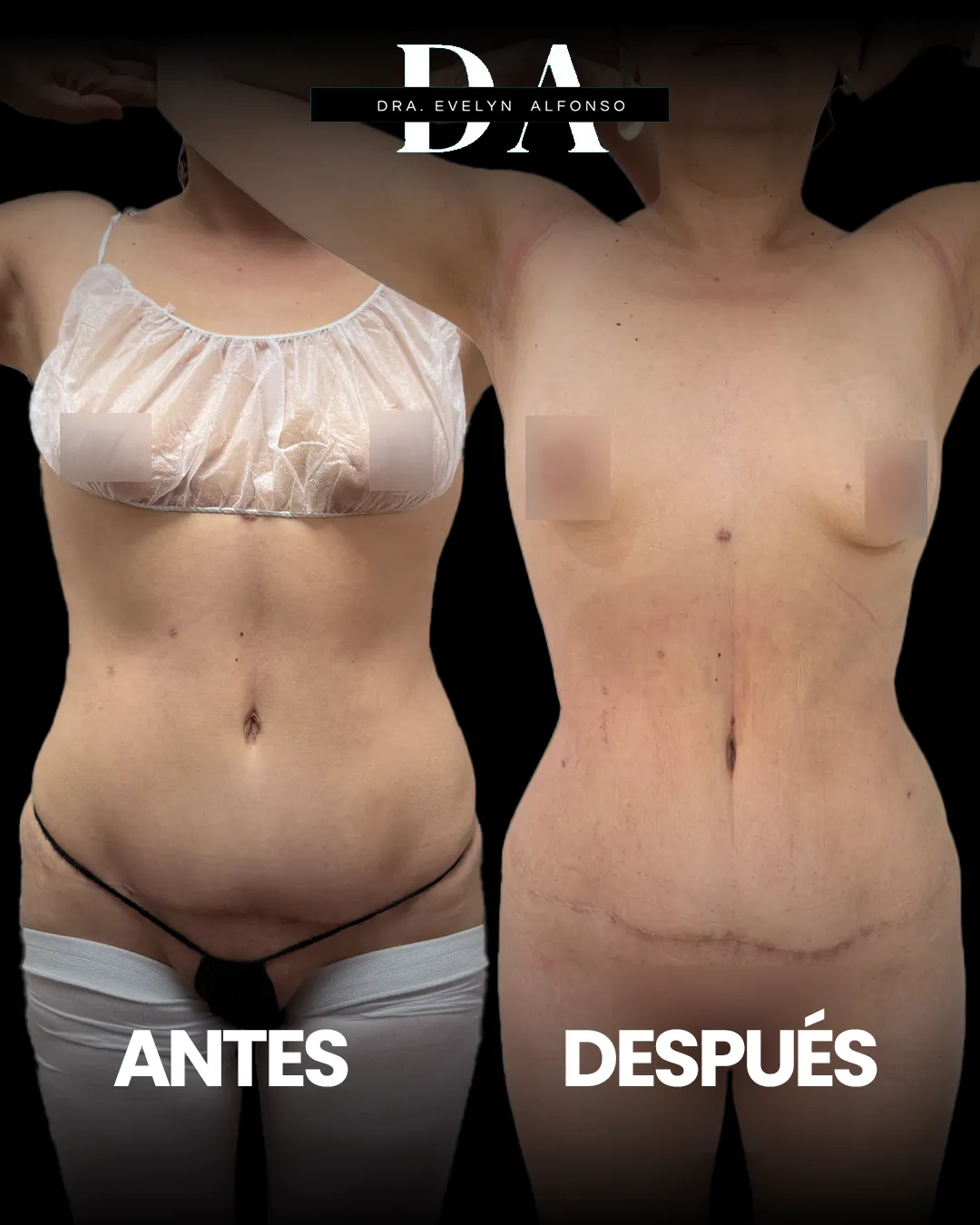
After a tummy tuck, it is fairly common to be left with localized fat deposits on the lower back and flanks (the so-called “bear ears”), which disrupt the transition between the waist, back and hips.
If this happened to you, you are not alone: it is a common concern. The tummy tuck improved your abdomen, but when you look at yourself from the side or from behind, you notice that your silhouette still does not look continuous. In this article we explain why it happens, how it can be corrected with precision liposuction, what to expect from recovery and which questions are worth asking at your evaluation. At the end you will see two real cases treated at Clínica Lumos.
Why does fat remain after a tummy tuck?
A tummy tuck is surgery designed mainly for the front abdominal wall: it removes excess skin, can repair the separation of the rectus muscles and redefines the belly button. Its focus is the front of the body. The lower back, flanks and lumbar area, on the other hand, are often left outside the treated area or are only partially addressed.
The result is that once the abdomen is flat, the neighboring fat deposits become more noticeable. Before, they went unnoticed because the whole contour had a similar volume; now the contrast between a firm abdomen and fuller flanks makes the waist look “cut off” or creates folds on the back when wearing tight clothing.
Contributing factors
- Fat distribution: some people tend to store fat in the lumbar area and flanks due to genetics and hormones, and that fat usually resists diet and exercise.
- Extent of the original surgery: every tummy tuck is planned differently. If liposuction of the flanks or back was not included, that fat is still there.
- Later weight changes: if your weight changed after surgery, the untreated areas may have gained volume.
- Skin quality: skin elasticity affects how the contour adapts and which technique is most appropriate.
Fat or skin: not the same thing
An important point: not everything that looks like a “bulge” at the ends of the scar is fat. Sometimes there is also a small amount of excess skin. Liposuction treats fat; if the main problem is excess skin, a different approach may be needed. That is why an in-person evaluation is key before deciding.
How it is corrected: precision liposuction
To redefine the transition between the waist, back and hips, liposuction is focused on the areas that still have volume. At Clínica Lumos we work with technologies such as VASER (ultrasound that emulsifies fat before it is suctioned) and LipoLaser, combined according to each case. The goal is not to “remove as much as possible,” but to sculpt: remove the deposits that break the line and leave a continuous, natural silhouette.
When there has already been a previous surgery, planning requires special care: there is scar tissue, blood flow in the area may have changed, and the abdominal result you already achieved must be respected. Dr. Evelyn Alfonso personally evaluates each case and leads the procedure.
Case 1: lower back area
High-precision liposuction of the lower back area was performed, removing residual fat deposits and redefining the contour for a more even silhouette.
Case 2: back and flanks with LipoLaser + VASER
This patient refined the contour of her back with a combination of LipoLaser and VASER, reducing localized fat in the lumbar area and flanks for a more defined waist and a natural transition between the torso and hips.
When is the right time to do it
There is no need to rush. After a tummy tuck, the body needs time for swelling to go down and for the tissues to settle. It is usual to wait until the result of that surgery is stable and the scar has matured before considering a contour touch-up. The exact timing is determined by the medical evaluation based on your progress.
It also helps to arrive at a stable weight. If you are in the middle of losing weight, ideally you should finish first, because liposuction does not replace that change and the result is easier to appreciate when your weight stays steady.
Step by step: what to expect
1. Evaluation
Dr. Alfonso reviews your previous surgery, the quality of your skin, where the fat is concentrated and what you would like to change. This is the moment to share your medical history, medications and habits, and to resolve your questions calmly.
2. Tests and preparation
Pre-operative tests are requested, and you can have them done at the clinic itself. You will receive instructions on diet, quitting smoking and medications. If you smoke, read why you should quit smoking before surgery.
3. Procedure
It is performed in an operating room authorized by the SEREMI de Salud (Chile’s regional health authority), with a plan defined in advance for each area. The technique and the combination of technologies are chosen according to your case.
4. Recovery
During the first few days there is swelling, tenderness and sometimes bruising. The compression garment and lymphatic drainage are prescribed case by case. Throughout treatment you have direct contact via WhatsApp for questions. You can read more in liposuction aftercare: compression garment and lymphatic drainage.
5. How the result evolves
The contour becomes more defined as the swelling goes down, and the final result takes months to fully appreciate. See when LipoVaser results become visible to have realistic expectations.
Practical tips for your recovery
- Follow the instructions on the compression garment, activity and follow-up visits to the letter.
- Walk gently from the start, as instructed, to promote circulation.
- Choose comfortable, loose clothing for the first few weeks.
- Eat a balanced diet and stay well hydrated. You will find ideas in diet before and after liposuction.
- Take photos in the same lighting and position to compare your progress; day to day, the changes go unnoticed.
- Be patient: swelling comes and goes during the first few weeks, and that is part of the process.
What to ask at your evaluation
Bringing your questions written down helps you make the most of the consultation and make an informed decision. Some useful questions:
- Is what I see on my flanks or back fat, skin or a mix of both?
- Which technique or combination of technologies is best for my case, and why?
- What change is realistic to expect, considering my skin and my previous surgery?
- What care will I need afterwards, and how much time should I set aside for my recovery?
- Which tests do I need, and where can I have them done?
- How do I contact the team if I have questions during the post-operative period?
A good evaluation also includes hearing what is not advisable. If the doctor suggests waiting, changing the approach or not having surgery, it is because the priority is your safety and a result that looks natural on your body.
Common myths
“If I had a tummy tuck, I can no longer have lipo”
Not necessarily. Many people can treat neighboring areas once the abdomen has recovered. What is required is a careful evaluation of the previous surgery.
“Lipo will help me lose the weight I gained”
Liposuction is not a weight-loss method: it treats localized fat to improve the contour. We explain this in liposuction and weight loss: myths and facts.
“With more exercise, those love handles will go away on their own”
Exercise is essential for your health and for maintaining results, but localized fat on the flanks and lower back often does not respond proportionally. That is why it is such a common concern.
Warning signs: when to seek care immediately
After any surgery, contact your medical team without waiting for your follow-up visit if you notice:
- Fever.
- Severe pain that does not ease with the instructions you were given.
- Difficulty breathing or chest pain.
- Pain, swelling or warmth in a calf.
- Spreading redness, foul-smelling discharge or an area that hardens and grows in size.
If symptoms are severe, go to an emergency room.
Is it right for you?
Liposuction treats specific areas that do not respond to diet or exercise. At the evaluation, Dr. Alfonso reviews your previous surgery, the quality of your skin and your goals. Learn about liposuction with LipoVaser and LipoLaser and the flank and waist results.
Frequently asked questions
How long should I wait after a tummy tuck?
It depends on your recovery. It is advisable to wait until the tummy tuck result is stable and the scar has matured. Dr. Alfonso determines the timing at the evaluation.
Can liposuction affect the result of my abdomen?
The procedure is planned precisely to respect what you have already achieved and to improve the transition with the neighboring areas. Tell the doctor all the details of your previous surgery.
Which areas can be treated?
The most requested areas in this context are the lower back, lumbar area and flanks, but every case is different. See which areas can be treated with LipoVaser.
Will I have to wear a compression garment again?
The compression garment is prescribed case by case, just like lymphatic drainage. Your doctor will tell you whether you need it and for how long.
I had surgery at another clinic. Can I still be evaluated?
Yes. Bring whatever information you have about your previous surgery; it helps with better planning.
When will I see the result?
Changes become visible as the swelling goes down, and the final result takes months. Every patient progresses at their own pace.
In summary
Being left with fat deposits on the flanks and lower back after a tummy tuck is common and has an explanation. With a proper evaluation, precision liposuction can help achieve a more natural transition between the waist, back and hips. What matters is choosing the right time, having realistic expectations and taking care of your recovery. If you want to know whether it is an option for you, book your evaluation at Clínica Lumos in Viña del Mar, about an hour and a half from Santiago.
Educational information. It does not replace a medical evaluation. Results vary from patient to patient.
Comments (0)
No comments yet. Be the first to ask!