

Trichological evaluation: what tests we do before a hair transplant
October 16, 2026 | by Dra. Evelyn Alfonso

Trichological evaluation: what tests we do before a hair transplant
October 16, 2026 · By Dr. Evelyn Alfonso
Before deciding on a hair transplant, it is essential to know why your hair is falling out, how much donor hair you have and what the result will look like. To answer that, at Clínica Lumos every patient goes through a trichological evaluation with Dr. Evelyn Alfonso and, if surgery is indicated, pre-operative tests.
- You are evaluated personally by Dr. Alfonso
- WhatsApp reply in under 1 hour
- 5.0 on Google · 33 reviews
Here we explain step by step what the process includes, why each stage matters and what you can do to arrive well prepared.
What is a trichological evaluation
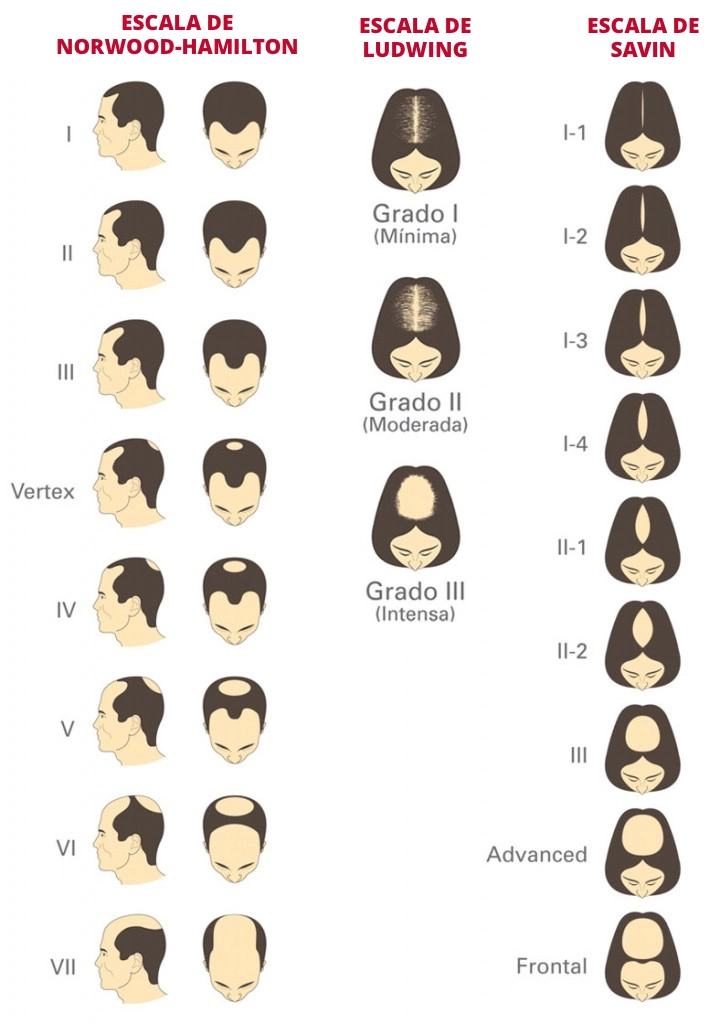
Trichology is the field of medicine that studies hair and the scalp. A trichological evaluation aims to do more than “see how much hair is missing”: it tries to understand what process is causing the hair loss, what stage it is in, how it might progress and which options make sense for you. It is the foundation of any decision, whether medical treatment, a non-surgical protocol or surgery.
This matters because there are different types of alopecia, and some look alike at first glance. Diffuse shedding can be a temporary effluvium, a progressing androgenetic alopecia or a mix of both. Only a detailed examination can tell them apart.
1. Trichological evaluation in the consultation
The first consultation focuses on your scalp and your history: when you first noticed the hair loss, family history, previous treatments and medications. With that, Dr. Alfonso performs the following studies:
Digital trichoscopy
A magnifying camera is used to examine the scalp and follicles in detail. Trichoscopy makes it possible to identify the type of alopecia —the most common is androgenetic—, see miniaturized follicles and detect signs of inflammation or other conditions that require treatment before, or instead of, surgery.
Miniaturization is one of the keys: in androgenetic alopecia hair does not disappear overnight, but becomes progressively finer. Seeing that difference in thickness between hairs helps confirm the diagnosis and anticipate how the hair loss might progress. At Clínica Lumos this analysis is complemented with AI-assisted trichoscopy.
Follicular density measurement
We measure how many follicular units there are per square centimeter and the thickness of the hair, both in the donor area (back and sides of the head) and in the recipient area. This figure determines how many grafts can be safely extracted without leaving the donor area visibly thinned.
The donor area is a limited resource: what is extracted does not grow back in that spot. That is why knowing its real density allows careful planning, thinking not only about today but also about what you might need in the future if alopecia keeps progressing in your native hair.
3D model of the head
A 3D reconstruction of your head is generated from photographs. This model helps plan the hairline design, estimate the area to be covered and calculate the grafts needed, and lets you see the plan in concrete terms before deciding.
For many patients, seeing the plan on a model makes it easier to understand why a particular hairline is proposed, or why one area is prioritized over another. It is also a good moment to talk about your expectations and adjust them to what is possible in your case.
For this first consultation you do not need any prior tests; just come with clean hair.
How to prepare for the first consultation
- Come with clean hair and no styling products such as gel, wax or hair fibers, so the scalp can be seen clearly.
- Write down your history: when the hair loss started, whether it was gradual or sudden, and what happened in the previous months (illnesses, surgeries, diets, stress).
- Make a list of medications and supplements you take, and of the hair treatments you have used.
- Bring recent tests if you already have them; they are not required, but they can provide information.
- If you have old photos, bring them: they help show how your hair has changed over time.
- Write down your questions so you do not forget anything during the consultation.
2. Pre-operative tests (if surgery is indicated)
If the evaluation confirms that you are a candidate for a hair transplant, before setting the surgery date tests are ordered to confirm that your general health is compatible with an outpatient procedure:
- Blood tests: complete blood count and other parameters as medically indicated, such as a thyroid panel, ferritin or vitamin D. Besides surgical safety, they help rule out causes of hair loss that are treated medically.
- Electrocardiogram: basic cardiac evaluation before surgery.
The specific tests are tailored to each patient according to their age, history and health status.
To make it simpler, pre-operative tests can be done at the clinic itself. That way you do not have to coordinate different places, and the results are available for the doctor’s review.
Why these tests matter
Although FUE hair transplant is an outpatient, minimally invasive procedure, it is still surgery. The tests help detect conditions that should be corrected beforehand, decide whether any adjustment to your usual medications is needed —which must always be indicated by a doctor— and operate under the best possible conditions. In addition, some results, such as iron deficiency or a thyroid disorder, can explain part of the hair loss and change the plan.
Along with the tests, safety depends on where the surgery is performed. At Clínica Lumos the procedure is performed in an operating room authorized by the SEREMI de Salud.
3. Diagnosis and treatment plan
With all the information, Dr. Alfonso presents a diagnosis and a plan: estimated number of grafts, a design agreed with you and the date of the procedure. If you are not yet a surgical candidate, she will guide you toward medical or non-surgical treatments to stabilize the hair loss. Read more in Am I a candidate for a hair transplant?
Non-surgical alternatives include the Hair Protocol, which is indicated according to the diagnosis. In other cases, the plan combines surgery with maintenance medical treatment to protect native hair, since a transplant does not stop alopecia in the follicles that are not transplanted.
The full process, summarized
- Step 1: consultation and trichological evaluation with Dr. Evelyn Alfonso.
- Step 2: trichoscopy, density measurement and 3D model.
- Step 3: diagnosis and proposed plan.
- Step 4: if surgery is indicated, pre-operative tests.
- Step 5: review of test results and date of the procedure.
- Step 6: surgery and follow-up, with direct contact via WhatsApp during treatment.
Why does a good evaluation matter?
A hair transplant redistributes a limited resource: your own follicles. A complete trichological evaluation avoids over-extraction, makes it possible to design a natural result for your age and hair loss pattern, and ensures the surgery is performed under safe conditions.
A rushed evaluation can lead to operating on alopecia that was not surgical, overharvesting the donor area or designing a hairline that does not keep up with the natural progression of hair loss over the years. Several of the correction cases we see originate in insufficient planning; we explain this in correcting a hair transplant done at another clinic.
Myths about hair evaluation
“A photo is enough to know how many grafts I need”
A photo can give a general idea, but it does not show density, hair thickness or miniaturization. The number of grafts is estimated through an in-person examination.
“If they ask me for tests, something must be wrong”
No. Pre-operative tests are standard for any surgery and aim to ensure you are operated on under the best conditions.
“The evaluation is just a formality to sell me surgery”
A good evaluation can also conclude that surgery is not the right choice today. That outcome is as valuable as a “yes”, because it avoids a procedure that would not benefit you.
Signs you should get checked soon
- Sudden appearance of bald patches.
- Itching, burning, pain, scabs or redness on the scalp.
- Heavy hair loss that lasts for several months.
- Progressive loss of density, especially at a young age.
Frequently asked questions
How long does the trichological evaluation take?
It depends on each case, but we take the time needed to learn your history, examine your scalp and discuss the plan. What matters is that you leave with your questions answered.
Do I need to bring tests to the first consultation?
No. For the first consultation you do not need any prior tests; just come with clean hair. If you already have recent tests, you can bring them.
Where do I get my pre-operative tests done?
Pre-operative tests can be done at the clinic itself, which simplifies coordination.
Does trichoscopy hurt?
No. It is a non-invasive test in which the scalp is examined with a magnifying camera.
What happens if my test results are abnormal?
The doctor will review the results with you. Depending on the case, it may be necessary to treat or investigate something before scheduling surgery, or to adjust the plan.
Can I have the evaluation if I come from another city?
Yes. Clínica Lumos is in Viña del Mar, about 1 hour 30 minutes from Santiago, and many patients travel for their evaluation. It is best to coordinate in advance.
In summary
A good decision about your hair starts with a good diagnosis. At Clínica Lumos, the evaluation includes your history, trichoscopy, density measurement and a 3D model; if surgery is indicated, blood tests and an electrocardiogram are added, which you can have done at the clinic itself. With that, Dr. Alfonso proposes a realistic plan, surgical or not. Learn about the FUE hair transplant in Viña del Mar and, when you are ready to take the first step, book your evaluation.
This information is educational and does not replace a medical evaluation. Results vary from patient to patient.
Hair Transplant and Liposuction in Viña del Mar, Valparaíso
Keep reading
Most read
RELATED POSTS
View all

Where are you losing the most hair? Alopecia patterns
October 23, 2026 | by Dra. Evelyn Alfonso

Where are we? Hair clinic in Viña del Mar: address, hours and how to get here
October 16, 2026 | by Dra. Evelyn Alfonso
Comments (0)
No comments yet. Be the first to ask!